It dates from the late Precambrian Era -- something on the order of 570 million years ago -- and is named after the Ediacara Hills of Australia, where rocks of that age are exposed at the surface. They're sometimes conflated with the Cambrian Explosion fauna like the ones in the famous Burgess Shale, but any connection between the two is tenuous at best. Not only are they separated by almost seventy million years, the Burgess Shale animals are (mostly) from phyla we know about. A few -- like the bizarre and aptly-named Hallucigenia -- have more obscure relationships to modern life, but most of the fossils we find there are identifiably proto-arthropods or proto-annelids or proto-whatnot. So while the Cambrian Explosion fauna is fascinating in its own right, by and large it's still fairly familiar ground.
Not so the Ediacaran Assemblage.
Not so the Ediacaran Assemblage.
These things are downright mysterious. Take, for example, the group called rangeomorphs.
They may have been animals, although they were sessile (fixed to the seafloor) via stalks, and had weird frond-like structures of uncertain purpose (but which may have been a mechanism either for oxygen extraction or for filter feeding). So if you were to look at a living one, your initial impression might well be that it was some odd sort of seaweed, and not an animal at all.

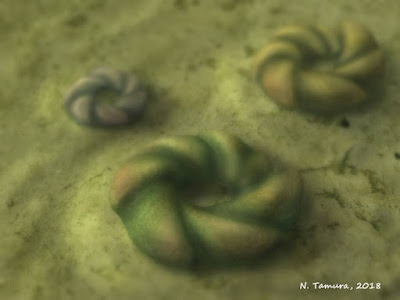
Not only are they bizarre-looking, many seem to have no living descendants, including Obamus coronatus (which looks like a French cruller) and the hubcap-like Tribrachidium heraldicum, one of the only known animals to have triradial symmetry.
There's a misconception about evolution -- that it's linear and progressive, that one form supersedes another in some kind of stepwise fashion based upon an identifiable "improvement," such as increase in speed, defensive or offensive capabilities, ability to access food, or intelligence. While you can find examples where this appears to have happened, there's a large measure of the chaotic involved in the history of life. Not only do we see sudden and drastic changes in the climate and environmental conditions -- which, after all, are the biggest drivers of selective pressure -- random occurrences like volcanic eruptions and meteorite strikes can create a situation where extinction had way less to do with poor evolutionary fitness than simply being in the wrong place at the wrong time.
They may have been animals, although they were sessile (fixed to the seafloor) via stalks, and had weird frond-like structures of uncertain purpose (but which may have been a mechanism either for oxygen extraction or for filter feeding). So if you were to look at a living one, your initial impression might well be that it was some odd sort of seaweed, and not an animal at all.

A 550-million-year-old fossil of the rangeomorph Charnia masoni, from the Mistaken Point Formation in Newfoundland [Image licensed under the Creative Commons Smith609 at English Wikipedia, Charnia, CC BY 2.5]
Not only are they bizarre-looking, many seem to have no living descendants, including Obamus coronatus (which looks like a French cruller) and the hubcap-like Tribrachidium heraldicum, one of the only known animals to have triradial symmetry.

Artist's reconstruction of Obamus coronatus [Image licensed under the Creative Commons Nobu Tamura (http://spinops.blogspot.com/), Obamus NT, CC BY-SA 4.0]
There's a misconception about evolution -- that it's linear and progressive, that one form supersedes another in some kind of stepwise fashion based upon an identifiable "improvement," such as increase in speed, defensive or offensive capabilities, ability to access food, or intelligence. While you can find examples where this appears to have happened, there's a large measure of the chaotic involved in the history of life. Not only do we see sudden and drastic changes in the climate and environmental conditions -- which, after all, are the biggest drivers of selective pressure -- random occurrences like volcanic eruptions and meteorite strikes can create a situation where extinction had way less to do with poor evolutionary fitness than simply being in the wrong place at the wrong time.
The Ediacaran Assemblage seems to have been on the unfortunate end of that particular equation. As I mentioned, the majority of them apparently left no descendants, not only today but even by the beginning of the next geological era. None of the bizarre Ediacaran life forms appear in the early Cambrian; the dominant animals five hundred million years ago show almost no resemblance to their predecessors seventy million years earlier.
In fact, the subject comes up because of a paper a few weeks ago in Geology suggesting that the wipeout of the Ediacaran Assemblage represents the Earth's first known mass extinction (not counting the Great Oxidation Event, of which the effect on life was uncertain but probably enormous). The new study uses recently-uncovered late Precambrian fossil beds that greatly add to the described Ediacaran biota, and the analysis found that we may well have been drastically underestimating the magnitude of the crash.
The researchers' data shows that what is known as the Kotlin Crisis, the biotic collapse that took out pretty much all of the Ediacaran life forms, may have wiped out as much as eighty percent of life on Earth. This easily places it amongst what paleontologists Jack Sepkoski and David Raup called the "Big Five" extinction events (the Late Ordovician, Late Devonian, Permian-Triassic, End Triassic, and Cretaceous-Tertiary extinctions). In fact, if the eighty percent number is correct, it would be in second place -- handily beating the sixty-odd percent of life destroyed in the famous Cretaceous-Tertiary extinction, and exceeded only by the cataclysmic Permian-Triassic "Great Dying."
So, what caused the Kotlin Crisis? At the moment, it's uncertain. It may have been a series of unfortunate events, including climate shifts, changes in oxygenation of the ocean, volcanic eruptions, and possibly the evolution of carnivory, but honestly, we're not sure. There are few enough rock outcrops of that age available to study that any determination is likely to be slow in coming.
But what's certain is that these (very) distant cousins of ours represent a road not taken -- a branch of the vast evolutionary tree of life on Earth that led to no descendants. It always makes me wonder what would have happened had they survived, and perhaps outcompeted, the bilateral, mobile forms that superseded them, and who ultimately became our ancestors. If -- in evolutionary biologist Stephen Jay Gould's evocative words -- we could re-run the tape, who would now be the dominant life forms on Earth?
Wouldn't be us, that's for damn sure. Maybe something like H. P. Lovecraft's bizarre pentaradial "Great Old Ones:"

[Image licensed under the Creative Commons Tom Ardans - blog - Facebook, Old One by Tom Ardans, CC BY-SA 3.0]
I can virtually guarantee that whatever it would have been, it'd be something so strange to our eyes that it would give even Darwin pause, despite all his blithe talk about "many forms most beautiful and most wonderful."
****************************************


No comments:
Post a Comment