Skeptophilia (skep-to-fil-i-a) (n.) - the love of logical thought, skepticism, and thinking critically. Being an exploration of the applications of skeptical thinking to the world at large, with periodic excursions into linguistics, music, politics, cryptozoology, and why people keep seeing the face of Jesus on grilled cheese sandwiches.
Showing posts with label editing. Show all posts

Wednesday, January 7, 2026

The printer's demon

Two days ago, I finished the draft of my historical novel Nightingale

I checked the document to see when I created it -- October 21, 2025.  Ten weeks and 96,600 words later, I've got a complete story, about a man in the thirteenth century who unwittingly becomes involved in treachery and double-dealing between the kings of France and Scotland, ends up cornered into committing an act that leads to chaos, and undertakes a pilgrimage to the Holy Land to atone.

Oh, and there's a ghost and a curse and a guy who may or may not be an angel.

It was an interesting tale to tell, and for sure the fastest I've ever written a whole novel.  I love the main character, Simon de Montbard, because he's complex and multi-layered, and also because he's a very unlikely hero.  I'm actually sad to say goodbye to him.

I'm doubly sad, though, because this propels me into my second-least-favorite part of being a novelist, which is:

Editing.

My first-least-favorite, of course, is marketing.  Most authors dislike it as well, but I have a special loathing for it, because I have a fundamental, reflexive hatred for self-promotion, coming from a childhood where I had beaten into me that Talking About Yourself Is Conceited And That's Bad.  When I was little, any time I mentioned anything I had accomplished, or even was interested in, it was met with "No one wants to hear about that," with the result that even now I come close to being physiologically incapable of bringing up creative stuff I'm doing in conversation.  (It's a little easier to write about it, obvs.  But even the mild level of self-aggrandizement I'm doing here is kind of uncomfortable.  Childhood trauma never quite goes away.)

This is why even doing stuff like posting a link on social media to my website or to one of my books on Amazon makes me immediately afterward run and hide under a blanket.  Probably explaining why my sales figures are so low.  It's hard to sell any books when I self-promote so seldom that it's met with "Oh, I didn't know you'd written a book!" when in fact I've written twenty-four of them.

Well, twenty-five, now.

In any case, now Nightingale goes into the editing stage of things, which is not anxiety-producing so much as it is tedious and a little maddening.  As my friend, the wonderful author K. D. McCrite, put it, "Editing is difficult because it's so easy to see what you meant to write and not what you actually did write."  I've had errors slip through multiple readings by multiple people -- not just simple typos or grammatical errors, but the bane of my existence, continuity errors:

Roses are red, Steve's eyes are blue
But you said they were brown back on page 52.

I can't tell you the number of times that I've caught stuff like a character opening a window that she just opened two pages earlier, or going down the stairs to the first floor when she started out in the basement.  I sincerely hope I have caught all of those sorts of things, because nothing yanks a reader out of the world of the story quite as quickly as that "... wait, what?" response when there's a problem with continuity.

However, I did learn something yesterday that should be a comfort to my fellow writers who have been reading this while nodding their heads in sympathy; errors, all the way from typos to major plot snafus, aren't your fault.  They're the fault of a demon named Titivillus who is in charge of making writers fuck things up.  Then when they do, Titivillus keeps track of all the mistakes, and when it comes time for God to judge the writers' souls, he reads out all the errors they've made so the writers will end up in hell.

Apparently people back then honestly thought Titivillus was real.  A fifteenth-century English devotional called Myroure of Oure Ladye has the lines, "I am a poure dyuel, and my name ys Tytyvyllus...  I muste eche day ... brynge my master a thousande pokes full of faylynges, and of neglygences in syllables and wordes."

Judging by the spelling, it looks like Titivillus has already racked up a few points just on that passage alone.

A fourteenth-century illustration of Titivillus trying to induce a scribe to screw up his manuscript [Image is in the Public Domain]

I must say, though, the whole thing strikes me as unfair.  If Titivillus is responsible for my errors, they're not really my fault.  Maybe the logic is that I should have concentrated harder, and not listened to him whispering, "What you mean to write is 'The man pulled on his trousers, then slipped on his shit.'"

What amazes me is how tenacious some of these errors can be.  As K. D. pointed out, our brains often see what we think is there and not what actually is there, with the result that we breeze right past goofs that you'd think would stand out like sore thumbs.  It's why all writers need good editors; you're not going to catch everything, no matter how carefully you think you're reading.  (And that's not even counting the fact that I seem to have a genetic condition that renders me incapable of using commas correctly.)

So now I need to go back through my own manuscript looking for faylynges and neglygences in syllables and wordes, before I turn it over to my actual editor, who no doubt will find plenty more.  As hard as the writing process can sometimes be, at least it's creative, whereas editing seems to me to be more like doing the laundry.  It's critical, and you can't get by without doing it, but hardly anyone would call it fun.

The whole thing reminds me of Dorothy Parker's quip.  "If you have a young friend who wants to become a writer, the second best thing you can do for them is to give them a copy of Elements of Style.  The first best, of course, is to shoot them now, while they're still happy."

Be that as it may, I still prefer editing over marketing.  So I'll just end by saying "Please buy my books, there are links to some of them in the sidebar."  Now y'all'll have to excuse me.  I'll be hiding under a blanket.

****************************************


Thursday, January 9, 2025

Guest post from Andrew Butters: Devil's in the details

Before we start, what are your thoughts on calling certain people Overzealous Grammar Reporting Enthusiasts instead of Grammar Na*is?  OGREs.  I think this works.  Hereinafter, that is how I will refer to them. With that out of the way, let’s get on with it.

***

I read just about everything Gordon Bonnet writes.  I read his blog, Skeptophilia, daily (well, six days a week.  He takes Sundays off.  He was also kind enough to crosspost this for me today).  Occasionally, I’ll find a typo.  When I do, I shoot him a message pointing it out, and he thanks me and then fixes it (though sometimes he fixes it and then thanks me.  Potato potato).  My response is the same when he does the same for my writing here or on Facebook.

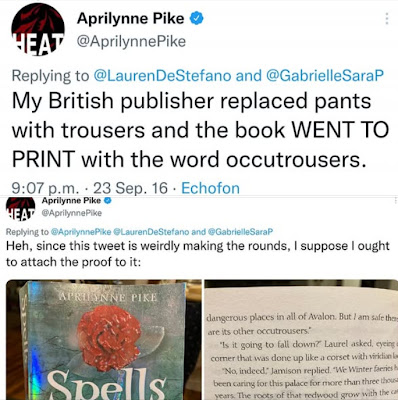
Tyops happen.  It's not an automatic sign that the writer was negligent.  It's not irrefutable proof that self-published authors are "lesser" when compared with traditionally published ones.  I’ve seen typos in Stephen King's books and from highly respected AP journalists.  Here’s a great example of a traditional publisher thinking that global search and replace was a good idea:


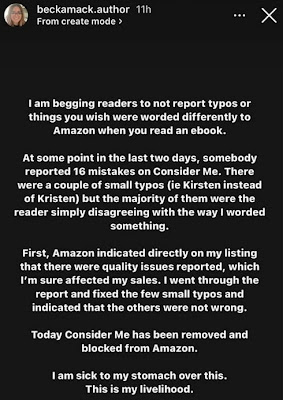
Readers who come across them vary.  Some ignore them and move on.  I typically ignore them, but if I were to find a shit-tonne, I'd stop reading and send the author or publisher a private message.  No need to make a scene.  That's me, though.  Some people latch onto them as if the fate of the literary world hangs in the balance (OGREs).  Take this example:


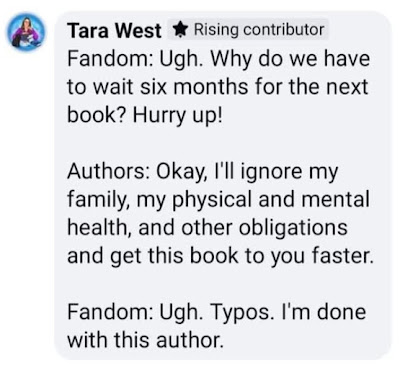
Now, I’m told that their book was reinstated after an outpouring of support from readers, but the fact that it happened should serve as a cautionary tale.  I scooped this screenshot from someone on Facebook, and one of the comments read (in part):
“You do your job poorly, there are consequences.  That’s how it works.  And no, if there is a typo in my book I AM telling Amazon because I want my money back.”
—Some OGRE on Facebook
It took all my willpower not to point out that Grammarly suggested not one but two corrections to his comment.  At any rate, I don't blame others for piping up if the typos are rampant.  The thing is, in my experience, books like that are rare.  I've read many books from established big names to first-time self-published authors and have yet to encounter one with enough errors to raise an eyebrow.  No, the plural of anecdote isn't data, but you get my point.  Sometimes shit happens.  Welcome to being human.  Unfortunately, not everyone sees it that way.


What follows is a true story.

I wrote Near Death By A Thousand Cuts over about a month, sometime in November 2022.  After writing, I let it sit for about a week.  Then, I started editing.  These were all personal anecdotes, so I didn't approach it like I would fiction.  The language was informal, and there was more swearing.

I made three passes of editing before sending it to my actual editor, who, in this case, happened to be Gordon (a great writer in his own right and a former teacher with an MA in linguistics).  I made the changes he recommended, adding a few more.

Then, I had seven beta readers go through it (reading critically, not just for fun), and THEY found errors.

Then, my mom (a former teacher) read it and found some stuff.

Then, I read the proofcopy and found more things.

Then, upon receiving what was supposed to be the final version to upload to KDP, I got a message from my layout designer.  SHE found a typo.

Like, holy shit.  Even after all the people and all the times this book was read, there was still a missing letter ("a" should have been "an").

Then, I recorded the audiobook, and guess what? I found MORE mistakes.

All that to say, editing is hard.

I have a good mind to send a link for Near Death to the OGRE from the quote above, with their high standards, and ask them to have a go at it.  I’d even refund them their money, forgoing my royalty and Amazon’s cut.

If you find a typo in my book Known Order Girls, I’ll mail you a bookplate (normally $5).  I extended this offer on Facebook, and someone took me up on it!  They were very kind, and I appreciate their eagle eyes catching something that made it through the editing gauntlet.

There will always be some asshole typo, waiting, lurking, biding its time, and making itself known only to that one reader who will fixate on it and leave a bad review as a result.

As Vonnegut probably wrote, "So ti goes."

****************************************

Tuesday, December 18, 2018

Toddler teleportation

I understand that wild, spooky, improbable explanations are more interesting than prosaic, ordinary ones, but really, people.

Get a grip.

This comes up because of a video that hit YouTube a couple of days ago that alleges to show a toddler teleporting into existence.  With no further ado, here's the clip:


So after watching this, what do you think is more likely?
(1) the editor of the video cut out a piece of the footage, making it look like a kid appeared out of nowhere.
or
(2) Your favorite of the following:
(a) It's a glitch in the Matrix, showing that we're all in an elaborate computer simulation, which works down to the last detail except for occasionally allowing small children to pop into or out of existence.
(b) The child is an alien who did the "energize, Scotty" thing and appeared on a street in Tewkesbury just in time to get caught in a television interview.
(c) The child is from the future.  Why (s)he came back here is a matter of conjecture, but some have suggested that (s)he is here to intervene and save the United Kingdom from Brexit.
(d) Blah blah blah lizard people blah blah Illuminati blah blah New World Order.
Okay, I have to admit to being a little startled the first time I saw it, but "I was a little startled" doesn't mean "I immediately jumped to the most ridiculous, convoluted explanation I can think of, and because I'm a fiction writer, I'm really good at thinking up ridiculous, convoluted explanations, so this is pretty impressive."

My pointing this out is probably a losing battle, however.  The subreddit r/Glitch_in_the_Matrix has, at present, 305,000 subscribers, and it's unwarrantedly optimistic to think that all of them are there just for the shits and giggles.  And there's got to be at least that many subscribers on subreddits and other websites about the Illuminati and New World Order, but I'm not going to go to said websites and find out, because They Are Always Watching and then They will know I'm checking them out and get suspicious and send the Men in Black to take me out and I'll never be heard from again.

You know how it is.


So this is yet another example of grabbing confirmation bias with both hands and running off the cliff with it, and I can say with some certainty that it makes a lousy parachute.  The bottom line is that most everything has a perfectly simple, rational explanation, and there is really no reason to seek out one that demands the existence of Matrices or aliens or time travel or lizard people.

Although Stephen Miller's most recent attempt at simulating a human being by applying paint-on hair does make me wonder about the lizard people.

********************************

This week's Skeptophilia book recommendation is Michio Kaku's The Physics of the Impossible.  Kaku takes a look at the science and technology that is usually considered to be in the realm of science fiction -- things like invisibility cloaks, replicators, matter transporters, faster-than-light travel, medical devices like Star Trek's "tricorders" -- and considers whether they're possible given what we know of scientific law, and if so, what it would take to develop them.  In his signature lucid, humorous style, Kaku differentiates between what's merely a matter of figuring out the technology (such as invisibility) and what's probably impossible in a a real and final sense (such as, sadly, faster-than-light travel).  It's a wonderful excursion into the power of the human imagination -- and the power to make at least some of it happen.

[If you purchase the book from Amazon using the image/link below, part of the proceeds goes to supporting Skeptophilia!]