Skeptophilia (skep-to-fil-i-a) (n.) - the love of logical thought, skepticism, and thinking critically. Being an exploration of the applications of skeptical thinking to the world at large, with periodic excursions into linguistics, music, politics, cryptozoology, and why people keep seeing the face of Jesus on grilled cheese sandwiches.

Monday, March 14, 2022

The merry-go-round of self-blame

Depression is, at its heart, a completely irrational condition.

One of the (many) therapists I've seen during my life told me that the way to deal with depression and/or anxiety was to do a reality check.  Is this feeling I'm having right now consistent with what I know reality to be?  It sounds good, but in practice, it's extraordinarily difficult to do.  Depression and anxiety make it harder for you to be certain what reality is.  The problem is that the depressed and/or anxious response feels just as real as reality does.  You can analyze those feelings in as dispassionate a way as you want, but when the things you're trying to discern seem to be equally plausible, you're in trouble.

One good example is my continual fear of talking too much or calling attention to myself in social situations, especially when I've had a drink or two.  If I'm stone-cold sober there's usually no question, because I hardly ever say anything, much less too much or the wrong thing.  But the inhibition-releasing tendency of alcohol consumption blurs the ability to self-perceive accurately, and afterward, I'm always convinced that I said more than I should have or something I shouldn't have, and nearly every time I have to appeal to my wife to do my reality checking for me.

This is why my reaction to a piece of research that appeared last week in the Journal of Psychiatric Research made me say, "Well, duh."  Not, understand, that I am at all critical of research to support what are honestly anecdotal claims; more that what they found is essentially how I live.  A team at King's College London, led by clinical psychologist in mood disorders Roland Zahn, studied the reactions of a group of test subjects -- some of whom had a history of suffering from depression, and others who did not -- to various hypothetical social interactions, and had them identify what would be their most likely responses if it were a real situation.

[Image licensed under the Creative Commons Sander van der Wel from Netherlands, Depressed (4649749639), CC BY-SA 2.0]

What the team found was that people who have depression tend to blame unpleasant social interactions on themselves, even if the circumstances make it unlikely that they were at fault.  "Self-blaming feelings such as guilt, self-disgust and self-directed anger are key symptoms of depression and Freud is widely credited for pointing to the importance of excessive self-blame in depression," Zahn said, in an interview in PsyPost.  "Social psychologists have done research into these so-called ‘action tendencies’, i.e. implicit feelings of acting in a certain way, such as hiding or creating a distance from oneself, which are entailed in complex feelings.  This is why my PhD student Suqian Duan set out to investigate this question.  In this study, we investigated blame-related action tendencies for the first time systematically in people with depressive disorders."

The response Zahn describes is strikingly similar to my experience of clamming up completely in social situations.  "Many people with a history of major depression, despite having recovered from symptoms, showed an action tendency profile that was different from people who had never experienced major depression and are thus at a lower risk of depression overall," he said.  "They were more likely to feel like hiding, creating a distance from themselves and attacking themselves when faced with a hypothetical scenario of acting badly towards their friend whilst being less likely to apologize.  Interestingly, we showed that the label of the emotion did not map one-to-one on specific action tendencies as was often assumed but rarely tested.  Feeling like attacking oneself was specifically associated with self-disgust/contempt, a feeling which we had previously found to be the most common form of self-blaming feeling in depression."

Zahn points out (correctly) that one of the difficulties is there is such a thing as reasonable guilt.  Purging oneself of all guilt feelings shouldn't be the goal; sometimes we feel guilty for a very good reason, and those feelings can prompt us to make amends for mistakes we've made.  "There is... a controversy around how to measure and define healthy forms of guilt, which help us to apologize and try to repair the damage we might have done from unhealthy forms of self-blame, where we take responsibility for things that are out of our control and feel paralyzed by our guilt or sense of failure, so that we hide away from the situation," Zahn explains.

The trouble is, with depression and anxiety, the ability to discern between justified and unjustified guilt or self-blame gets blurred, and depression and toxic narcissism lead to opposite and equally damaging false conclusions; the former, that every negative interaction is our fault, the latter that none of them are.

It's hard to see, in the absence of someone like my wife to do an external reality check, what you could do to get off the self-blame merry-go-round.  When the heart of the problem is an inaccurate but compelling view of oneself and the situation, trying to do any kind of internal reality check is likely to meet with limited success.  That's certainly been my experience.  I can even go into a social situation with the mantra, "I know I don't talk too much, everything is going to be fine, I should loosen up and just chat with people," but afterwards the inclination to self-blame anyhow is awfully powerful.

No wonder we feel like hiding a lot of the time.

**************************************

Saturday, March 12, 2022

Re-examining the ganzfeld

Today's post asks a question not because I'm trying to lead you toward a particular answer, but because I honestly don't know the answer myself.

In Wednesday's post, I discussed some alleged claims by psychics (which a team in Australia evaluated for accuracy and found seriously wanting) and made the statement, "I'm all for keeping an open mind about things, but at some point you have to conclude that a complete absence of hard evidence means there's nothing there to see."

A friend of mine responded, "What if there's hard evidence out there that you're choosing not to accept because you've already made your mind up?"  He wasn't being combative; like me, he was just asking a question, and it's actually a reasonable thing to ask.  And he sent me a link to a post over at Paranormal Daily News that looks at one of the most famous experimental setups for detecting psychic powers: the ganzfeld experiment.

"Ganzfeld" is German for "complete field," and refers to the fact that the test subjects are placed in near-complete sensory deprivation, in order to keep them from receiving any information accept (allegedly) from telepathy.  Padded goggles are placed over the eyes; earpieces play recordings of white noise.  The subjects lie flat in a place with no drafts or other air movement.  (Some have even had subjects floating in a sensory deprivation tank.)  Then the "sender" -- usually the researcher conducting the experiment -- looks at some kind of pattern, often the famous "Zener cards" (cards with five different geometric patterns in five different colors), and the "receiver" (the test subject) reports what (s)he sees/experiences.

A participant in a ganzfeld experiment [Image is in the Public Domain]

The Wikipedia page for the ganzfeld experiment (linked above) is unequivocal; it says, "[It] is a pseudoscientific technique to detect parapsychological phenomena...  Consistent, independent replication of ganzfeld experiments has not been achieved."  However, the article my friend sent is equally unequivocal in the opposite direction -- that it has generated results that are far outside of what would come out of a random-choice statistical model, and has been done over and over with the same outcome.  The author, Craig Weiler, writes:

This works.  Not perfectly, but certainly well enough for an experiment.  It’s been done more than enough times by more than enough people to rule out any statistical anomalies.  The success rate is typically between 32 and 35%.  That’s pretty normal for a successful, statistics based experiment.  There have been six different meta analyses from skeptics and researchers alike, all showing positive results.  From an objective scientific perspective, this is an ordinary successful scientific experiment.

While I can't say I warm to the sneery tone of the article -- Weiler really needs to learn the difference between a "skeptic" and a "scoffer" -- it does bring up the question of who's right, here.  The critics of the ganzfeld experiment and other such attempts to prove the existence of paranormal abilities claim that no sufficiently-controlled experiment has ever generated positive results; the supporters claim that there are plenty of positive results that all the scientists are ignoring because they can't explain them (or, worse, because those results contradict their own biases).

Weiler is right that there have been meta-analyses done of the ganzfeld results, and that they have changed the minds of neither the pro- nor the anti- factions.  Finding a truly unbiased analysis has turned out to be not to be easy.  A September 2020 article in Frontiers in Psychology by Thomas Rayberon comes the closest of anything I've seen, but unfortunately tries to steer a middle course of "maybe, maybe not" by agreeing with both sides at once even though they're saying opposite things.  Rayberon writes (citations have been removed in the interest of space; go to the original article if you're interested in seeing them):

Psi research can be considered as a subfield of consciousness studies concerned with interactions between individuals and their environment that transcends the ordinary constraints of space-time.  Different lines of research have been developed for more than a century to tackle psi using experimental research, spontaneous cases, clinical cases, selected participants, and applications.  Several meta-analyses of studies conducted under controlled conditions examine precognitive dreams, telepathy, and presentiment and have demonstrated statistically significant effects...

While these results support the existence of consistent anomalous experience/behavior that has been labeled “psi,” there is currently no consensus in the scientific community concerning their interpretation and two main positions have emerged so far.  The “skeptics” suppose that they are the consequences of errors, bias, and different forms of QRPs [questionable research practices].  The “proponents” argue that these results prove the existence of psi beyond reasonable doubt and that new research should move on to the analysis of psi processes rather than yet more attempts to prove its existence.  This absence of consensus is related to the difficulty of drawing firm conclusions from the results of psi research.  Indeed, they represent an anomaly because there is currently no scientific model – based on physical or biology principles – to explain such interactions even if they exist.
Which reminds me from the quote from Lord of the Rings, "Go not to the Elves for advice, for they will say both yes and no."  The last bit -- that there is no current scientific model that could account for psychic phenomena -- is certainly true; but if there are statistically significant effects (which Rayberon says explicitly in the preceding paragraph), then surely there must be some protocol for devising an experiment that meets the minimum criteria of the true skeptics (people who base their understanding on the evidence, regardless of what their preconceived notions might have said).  The fact that there is no current scientific model to explain telepathy is, while correct, entirely irrelevant.  The first thing to do is to determine if the phenomenon itself is real.  There was no scientific model to explain radioactivity when it was discovered by Henri Becquerel, nor the apparent constancy of the speed of light when it was demonstrated by Michelson and Morley, nor the patterns of inheritance uncovered by Gregor Mendel.  The first thing was to determine if what they were seeing was accurate.  Once that happened, the scientists moved on to trying to figure out a model that accounted for it.

Rayberon then goes on to make quite a puzzling statement that implies it might be impossible even to tell if the phenomenon is real.  Science, he says (again, correct most of the time) uses experimental protocols that eliminate any possibility of interference by the experimenter.  That's impossible in psi research (italics are the author's):
Thus, if psi exists, the problem is the following: an advertent or inadvertent “direct” interaction between the researcher and the object of study could be possible.  This destroys the conditions necessary for the convincing scientific demonstration of psi itself.

Rayberon says this "paradox" makes psi research impossible to confirm or disconfirm.  But isn't an interaction between the researcher and the test subject what the psi researchers themselves are trying to demonstrate?  What an honest psi researcher -- well, any honest researcher, really -- needs to do is to isolate the variable (s)he's studying so that, as far as is possible, whatever results come out of the experiment can only be attributable to that variable.  So in a properly-conducted ganzfeld experiment, the researcher has eliminated any possibility of the test subject getting information about the pattern from anywhere except the mind of the "sender."

And from my admittedly layperson's viewpoint, that can't be all that hard to do.  If there have been multiple instances of positive, statistically-significant results from ganzfeld trials -- and Weiler and Rayberon agree that there have been -- then they deserve some explanation other than shrugging and saying, "I don't see how it could work."  If there are "errors, biases, and questionable research practices" generating the results, the "skeptics" (using the word in the sense both Weiler and Rayberon use) need to determine what those are.  If, on the other hand, the results aren't from poor experimental design or outright cheating, then let's have the "skeptics" and "proponents" team up to find a protocol they can both agree to.

Figuring out a model for what's going on can wait until we see if there is anything going on.

So after accusing Rayberon of playing both sides, I'm honestly not doing much better.  My inclination is to doubt the existence of psi abilities because the evidence seems sketchy for such a wild claim.  But that inclination is a bias I'm well aware of, and all it would take is one sufficiently well-designed experiment to convince me I was wrong.  Right now, all that seems to be happening is both sides becoming more entrenched and yelling at each other across no-man's land, which doesn't accomplish much but pissing everyone off.

So come on, folks.  Either psi exists or it doesn't.  If it doesn't, we can go on to studying actual real phenomena.  If it does, it will overturn pretty much everything we know about psychology, and would be one of the most colossal discoveries in the past hundred years.  How about teaming up and settling this question once and for all?

**************************************

Friday, March 11, 2022

A hole in the ground

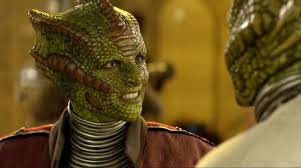
In the Doctor Who episode "The Hungry Earth," a scientist named Nasreen Chaudhry is trying to break the previous record for deep drilling into the Earth, ostensibly to find the source of some minerals that seem to occur nowhere else, but also because "let's see if we can actually do it."  The team running the drill is trying to send it down 21 kilometers, and it just about reaches the target depth when...

It suddenly shuts down.  The reason, it turns out, is that it is endangering an underground colony of hibernating Silurians, the reptilian race that used to be Earth's dominant species, and some of them were automatically awakened when the threat was detected, and proceeded to sabotage the drill -- and head up to the surface to destroy the humans who had created it.  The resulting conflict is anything but a quick good-guy-vs.-bad-guy story.  It explores all sorts of uncomfortable topics like xenophobia, fanaticism, righteous and unrighteous anger, revenge, and how hard it can be to trust when you don't know what the other person's motives are.  Some of the Silurians come out looking pretty awful -- but then, so do some of the humans.


I couldn't help but think about this episode when a friend of mine, the wonderful writer and blogger Andrew Butters (of Potato Chip Math, which you all should subscribe to right now) sent me a link to an article in Vice describing a project that is doing the exact same thing.

The company is called Quaise Energy, and at least is doing it for sound reasons.  The borehole, which is projected to be almost twenty kilometers long when it's completed, beats the previous record (twelve kilometers) by a large margin).  The idea is that down that deep, the rock is being heated by the mantle, and it would be a nearly limitless supply of geothermal energy -- literally, just pump water down pipes inside the borehole, and the return pipes will bring up steam that can then be used to generate electricity.  (They already do this, on a much smaller scale, in Iceland; the boreholes can be far shallower there, because the island sits right on top of the Mid-Atlantic Rift Zone, and is one of the most volcanically active places in the world; in some places, all you have to do is dig down a few inches and the soil is hot to the touch.)

At twenty kilometers down, the ambient bedrock temperature is about 500 C, so there's no question that the energy is there.  Getting down that far, however, is no mean feat; they're using collimated lasers called gyrotrons, which can burn through rock, so unlike the unfortunate drill team in Doctor Who, there's less machinery to get jammed up, or sabotaged by lizard people from the dawn of time, or whatever.

The nice thing about this is that it's about as close to zero carbon footprint as you can get.  "This funding round brings us closer to providing clean, renewable baseload energy," said Carlos Araque, CEO and co-founder of Quaise Energy.  "Our technology allows us to access energy anywhere in the world, at a scale far greater than wind and solar, enabling future generations to thrive in a world powered with abundant clean energy."

All of that sounds great, and it's nice to see people putting time, energy, and money into ways to unhook us further from fossil fuels.  And fortunately, there probably are no Silurians down there, so the overall risk is fairly low.  The hope is that when they get proof-of-concept from the first borehole, it might be an incentive to place them elsewhere.  The best thing about geothermal is not only that it's effectively limitless, but once you get the pipes and pumps in place, it needs very little maintenance, and no additional expense for fuel; some of the electricity produced by the steam can be siphoned off to run the pumps, and the rest of it is essentially free energy.

So I'm all for it, and I hope the project proceeds quickly, because heaven knows we need better and cleaner energy sources.  I'd love it if there was geothermal here where I live -- because in this region our electricity is mostly from coal, and our house is heated with fuel oil (supplemented considerably, I have to add, by our solar panels.)  On the other hand, if a super angry reptilian military leader suddenly bursts out of the borehole and starts killing people who get in her way, I'm gonna be right the hell out of here.

**************************************

Thursday, March 10, 2022

Sweet synchrony

I really am extraordinarily lucky.

Following the breakup of my (all things considered) disaster of a first marriage, I had pretty much figured that was it for romantic entanglements.  Then in November of 1999, a mutual friend introduced me to a woman named Carol who loved travel, dogs, birdwatching, music, the outdoors, and red wine, saying that there was no way two people so similar shouldn't get together.  With some hesitation -- both due to my earlier decision to avoid dating, and a hefty dose of social awkwardness -- I asked her out.

It soon became obvious we were soulmates.  We'd only been dating for six weeks when I said, just making a joke, "I'm going to take a trip to Iceland -- want to come with me?"  I was fully expecting her to say, "Iceland?  Why the hell would anyone go to Iceland?"

What she said was, "When do we leave?"

Our courtship was, in many ways, a comedy of errors, appropriate enough in retrospect given the screwball comedy our life together has turned out to be.  Our second trip overseas, to Belize, was great fun -- till we (and everyone else in the camp where we were staying) simultaneously got food poisoning.  It only lasted twelve hours, but was absolutely the sickest I've ever felt.  I won't go into gruesome details, but I'll just say that after we recovered, Carol remarked that if two people can coexist in a small cabin while elbowing each other out of the way every fifteen minutes to make it to the bathroom in time, without one of them killing the other, it has to be a match made in heaven.

I agreed.  After two more years of wild adventures (and no repeats of the Belize incident, fortunately), in July of 2002, we decided to make that match permanent.

Kind of amazing how well I clean up, honestly.

Now, almost twenty years later, we've only discovered more and more ways we're similar.  I can't tell you the number of times one of us has said something completely random, and the other has looked shocked and said, "I was just about to say exactly the same thing."  We are alike in good ways and bad -- we've also frequently remarked about how our less-praiseworthy habits reinforce each other.  This is particularly obvious when it comes to tidiness.  We've been told that our décor style is called "shabby chic."  I don't know about the "chic" part, but we've got "shabby" locked up.  Our approach to housekeeping can best be described as "There appears to have been a struggle."

But along the way we've had a huge amount of fun, even if finding out visitors are coming induces a panicked frenzy of vacuuming, mopping, sweeping away cobwebs, and putting away piles of books, art work, pottery, dog toys, and weird assorted souvenirs from various trips that have been strewn about for months.  But you can only do so much.  Even afterward, our house looks like a poorly-maintained museum.

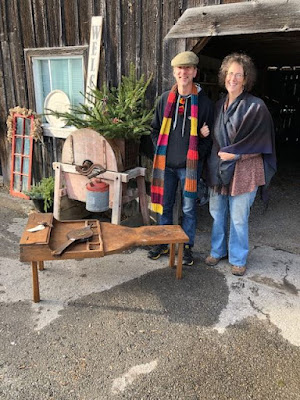
On a trip to Canada a couple of years ago, while visiting an antique store.  The cobbler's bench in front of us is now our coffee table.

The adventures have never stopped.

Cape Cod, Massachusetts

Mevagissey, Cornwall, England

I still periodically find it baffling that she puts up with my rather squirrelly personality, navigating my yo-yoing moods with apparent aplomb.  All I know is what I started out with: I am damn lucky.

And I found out just day before yesterday that our rapport forecasts a long and happy future.  According to a study of 154 couples published last week in the Journal of Personality and Social Psychology, couples who have the kind of spark Carol and I have tend to gain both in satisfaction and longevity.

"Couples in the study varied greatly in... measures of positivity resonance, with some couples showing dozens of moments of emotional and physiological synchrony and others showing few or none," said psychologist Robert Levenson, of the University of California - Berkeley, who co-authored the study.  "We focused on those fleeting moments when you light up together and experience sudden joy, closeness and intimacy.  What we found is that having these brief shared moments, known as ‘positivity resonance,’ is a powerful predictor of how healthy we’re going to be in the future and how long we’ll live."

Which is cheering.  Even more fascinating is that that resonance goes all the way down to the physiological level -- couples who scored high on the assessment not only synchronized such obvious social cues as smiling and laughing, their heartbeats and breathing synchronized, as did their blood levels of such powerful (positive) mood regulators as serotonin and oxytocin.

So this all bodes well for Carol and me.  That said, I have to say that there are ways we're not alike; for example, our approach to shopping.


Carol will comparison-shop for paper towels.  I, on the other hand, am so impulsive I'm flat-out dangerous to have by your side when there's a big purchase.  Part of it is that I loathe shopping so much that I'll do damn near anything, including paying twice as much as I should, just to get it over with.  I really related to the anecdote that humor writer Dave Barry tells, when he and his wife were looking for a house to buy:
Dave Barry:  This is just perfect!  I love it!  I think this is ideal, don't you, dear?

His wife:  We're still in the real estate office.

In any case, the similarities vastly outweigh the differences, and even our unfortunate shared tendencies, not to mention our differences, are ameliorated by the fact that we're both pretty accepting of each other's foibles.  So the Levenson et al. study is really immensely cheering.  I'm looking forward to many more years together, traveling, playing with dogs, drinking wine, and navigating our way through the chaos of our shabby chic lives.

**************************************
Wednesday, March 9, 2022

Should've seen that coming

Self-proclaimed psychics hated James Randi, the venerable debunker of all things paranormal, who died in October 2020 at the honorable age of 92.  On one hand, it's obvious why; he loathed charlatans, especially those who in plying their trade rip off the gullible to the tune of thousands of dollars.  But honestly, there's a way in which Randi shouldn't have been so detested by the psychics.  After all, he wasn't saying, "Your claim is false and you're lying," he said, "Show me under controlled conditions that you can do what you say you can do."  Which you'd think is fair enough.  Given how many people out there claim to have paranormal abilities, it seems like at least one or two of them would have made a credible case (especially since the James Randi Foundation was offering a million dollar prize for the first person who could succeed).

But no.  Not one single person ever met the minimum criteria for scientifically-admissible evidence; in fact, very few psychics even took the bait.  A few of them said they wouldn't put themselves in the situation of having to demonstrate their ability in a situation where Randi's "atmosphere of suspicion and distrust" would interfere with the psychic resonant energy fields (or whatever), but most of them wisely decided to stay silent on the matter and ignore the challenge completely.

And it worked.  Being a psychic is as lucrative as ever.

[Image licensed under the Creative Commons Gunnshots (Don), Psychic reading, CC BY-SA 2.0]

Of course, since what the psychics do is make predictions, we don't even need Randi's method to check and see if there's anything to their claims; we can merely look back at the yearly predictions, and see what percentage of them were correct -- and if that hit rate exceeds what we'd expect from pure chance.

Which is exactly what a group of skeptics in Australia did.  The Great Australian Psychic Prediction Project, which just announced their results last week, analyzed 3,800 predictions made in the past twenty years by 207 self-styled psychics, and put each into one of five categories:
  • Expected (such as Simon Turnbull's prediction in 2000 that "one area that is going to do fantastic stuff is the internet, specifically areas like shopping.")
  • Too vague to call (such as Sarah Yip's statement in October 2020, "Who will win the U.S. election? … the numerology shows that both Mr. Trump and Mr. Biden have a chance of winning the next U.S. presidential election.  It is still up to the people to decide.")
  • Unknown/unverifiable (the smallest category, comprising only a little over two percent of the candidate claims)
  • Correct
  • Flat-out wrong (my favorite of those is Sarah Kulkens's 2007 claim that "Using anti-gravity to lift heavy objects will become a reality instead of a dream.")
The results are interesting, to say the least.  The "flat-out wrong" category amounted to 53% of the total, which doesn't seem too bad until you look only at the claims that were either verifiable and correct, or verifiable and wrong -- at which point the "wrong" category balloons to 83%.

Not a very impressive showing.

This gets even worse when you consider the major world events that every one of the 207 psychics involved in the study missed entirely.  These included:
  • the 9/11 attacks
  • the 2003 burn-up on reentry of the space shuttle Columbia
  • the 2004 earthquake and tsunami in the Indian Ocean that killed over 200,000 people
  • the 2011 Fukushima earthquake, tsunami, and nuclear disaster
  • Notre Dame Cathedral burning down in 2019
  • the outbreak of the COVID-19 pandemic
You'd think that events of this magnitude would have caused at least a small disturbance in The Force, or whatever the hell they claim is happening, but no.  The psychics were as caught off guard as the rest of us.

I'm all for keeping an open mind about things, but at some point you have to conclude that a complete absence of hard evidence means there's nothing there to see.  On one hand, I understand why people want psychic abilities to be real; it gives some kind of plan or pattern to what seems otherwise like a chaos-riddled reality.  But as my grandma used to tell me, "Wishin' don't make it so."  I've never found that the universe is under any obligation to conform to what I'd like to be true.

Or, as science writer and novelist Ann Druyan said, much more eloquently:
[Science] is a never-ending lesson in humility.  The vastness of the universe—and love, the thing that makes the vastness bearable—is out of reach to the arrogant.  This cosmos only fully admits those who listen carefully for the inner voice reminding us to remember we might be wrong.  What’s real must matter more to us than what we wish to believe.  But how do we tell the difference?

I know a way to part the curtains of darkness that prevent us from having a complete experience of nature.  Here it is, the basic rules of the road for science: Test ideas by experiment and observation.  Build on those ideas that pass the test.  Reject the ones that fail.  Follow the evidence wherever it leads.  And question everything, including authority.

**************************************

Tuesday, March 8, 2022

Fox on the run

Seems like for each of the last few years, we've said, "Well, at least next year can't be as bad as this year was!"  Then, somehow, it is.  Or worse.  As a friend of mine put it, "I'd like to find out who started this worldwide game of Jumanji and punch the shit out of him."

And of course, with so many things going wrong, people start casting about for some kind of underlying cause (other than "humans sure can be assholes sometimes").  I wasn't surprised, for example, that the extremely Reverend Pat Robertson said the invasion of Ukraine by Russia was a sign that the End Times were beginning.

Well, "not surprised" isn't exactly accurate, because I honestly thought Pat Robertson was dead.  What is he, like 124 years old?  In any case, once I realized that he's still alive, his reaction wasn't surprising, because he thinks everything is a sign of the End Times.  I have this mental image of him shuffling around his house in his bathrobe and jamming his little toe on the leg of the coffee table, and shouting, "And the Lord sayeth, 'When thou bangest thy toe on the furniture, prepare ye well, for the Four Horsemen are on their way!  Can I get an amen?"


So I suppose it's natural enough to look for a reason when things start going wrong, even though in my opinion, Pat Robertson is nuttier than squirrel shit.  But in any case, now we have another candidate for an explanation besides the End Times as predicted in the Book of Revelation:

The Japanese Killing Stone spontaneously split in half last week.

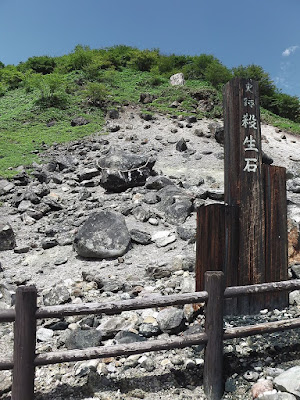
If you haven't heard of the Japanese Killing Stone, well, neither had I until I read that it had fallen apart.  Its Japanese name is Sessho-seki (which literally means "killing stone"), and it's near the town of Nasu, Tochigi Prefecture, in central Honshu.  The story is that there was a beautiful woman named Tamamo-no-Mae, who was actually a kitsune (an nine-tailed fox spirit) in disguise.  She was working for an evil daimyo (feudal lord) who was trying to overthrow the Emperor Konoe, but she was exposed as a fox spirit and killed by the warrior Miura-no-Suke, and her body turned into a stone.

But her evil influence didn't end there.  Tamamo-no-Mae's spirit was locked inside the stone but kept its capacity for inflicting harm, and anyone who touched it died.  The site of the stone is cordoned off; the Japanese government says it's because the area is volcanic and there are sulfurous fumes that could be dangerous.

Sessho-seki [Image is in the Public Domain]

To which I respond, "Sure, that's the reason.  Mmm-hmm."  I mean, really.  What am I supposed to believe?  That there are purely natural dangers caused by understood geological processes, or that the spirit of an evil nine-tailed fox woman has been trapped inside a rock that can kill you when you touch it?

I know which one sounds the most plausible to me.

Tamamo-no-Mae and Miura-no-Suke, as depicted by Utagawa Kuniyoshi (1849) [Image is in the Public Domain]

So anyway, apparently people are freaking out that the rock spontaneously split in half, despite the authorities saying, "A small crack had appeared naturally some years ago, and grew deeper until finally the stone fell apart."  The idea is now that the Sessho-seki has split, it released the spirit of Tamamo-no-Mae, who will proceed to wreak havoc once again.

My response is: go ahead, Foxy Lady, do your worst.  My guess is anything you could do would pale in comparison to what's already going on in the world.  It'd be kind of an anticlimax, wouldn't it?  You wait for centuries, trapped inside a rock, concocting all sorts of evil plans, and then the rock breaks and releases you, and you explode out and start causing trouble, and... no one notices.  

Tamamo-no-Mae: Ha ha!  I am free!  I shall cause chaos wherever I go!  The weather shall go haywire!  Wars will break out!  The evil shall go unpunished!

Us:  Is that all?

Tamamo-no-Mae:  Um... what do you mean, is that all?  Isn't that bad enough?

Us (laughing bitterly):  Look around you.  You think you can do better than this?

Tamamo-no-Mae (horrified):  Oh.  Oh, my.  Okay... um... do you think you could get some Superglue and help me put this rock back together?

Us:  Yeah, it'd probably be for the best.  Can you take us with you?

Anyhow, if things start getting worse, and you're wondering what's the cause, maybe it's the depredations of an evil nine-tailed fox spirit from Japan.  And after all, the whole "End Times" thing is getting a little hackneyed, don't you think?  Especially since the evangelicals have been predicting the End Times several times a year for hundreds of years, and nothing much has happened.  Not even one Apocalyptic Horseperson, much less four.  So at least this would be a new and different reason as to why everything's so fucked up lately.

Makes as much sense as any other explanation I've heard, although there's still something to be said for "humans sure can be assholes sometimes."

**************************************
Monday, March 7, 2022

The anchor and the lifeline

129 years ago, Bertha Viola Scott was born in the little town of Wind Ridge, in Greene County, Pennsylvania.  She was the fourth child of Thomas Iams Scott and Nancy Elizabeth "Lizzie" (Donahoo) Scott; they would go on to have four more.

Her life wasn't easy, pretty much from day one.  Thomas Scott was a ne'er-do-well, with a reputation as a philanderer, and was gone from the home more often than he was there.  Lizzie was a kind person and a good mother, but in 1903 -- when Bertha was ten -- she died in a typhoid epidemic.

Thomas Iams Scott and his mother, Mary (Iams) Scott, ca. 1915

"Lizzie," Nancy Elizabeth (Donahoo) Scott, ca. 1880

The seven Scott children -- one of them, Clarence, had died as an infant -- were farmed out to various uncles and aunts.  Bertha and her two older sisters, Roxzella Vandell Scott ("Zella") and Fannie Elinore Scott ("Fan") decided they had to look after the younger ones to make sure they were being treated fairly, and became the surrogate mothers to their siblings.

Top row, l. to r.: Zella (Scott) Knoderer and her husband Cecil Clair Knoderer
Bottom row, l. to r.: Donald Jacobs (the Scott children's first cousin), Bertha Viola Scott, Albert Romer, and his wife Fan (Scott) Romer (ca. 1912)

In around 1914, when Bertha was 21 years old, she and a younger sister (Florence, then age twelve) upped stakes and moved to southern Louisiana.  I've never known why it was they made the move; to my knowledge, no one else came with them.  They were dirt poor, so it definitely wasn't a pleasure excursion.  It may have had something to do with the beginning of World War I, but if so, I don't know what.  In any case, both of the young ladies met and married someone from Louisiana -- Bertha married a small equipment repairman named Alfred Joseph Bonnet in 1915, and Florence a man from New Orleans named Kirby Lodrigues in 1924 -- and both of them lived in the state for the rest of their lives.

Alfred was a gentle, soft-spoken man, fifteen years Bertha's senior.  They had two children, both sons; Raymond Joseph in 1916, and Gordon Paul -- my father -- in 1919.

My Grandma Bertha and my dad, ca 1927, along with some of their numerous pets

Life didn't get a great deal easier for them.  In 1940, Alfred -- then 61 years old -- died of a sudden and massive heart attack.  My grandmother was widowed at only 47.

My grandfather, Alfred Joseph Bonnet, ca. 1930

My grandmother had no particular training that would have qualified her for a job -- she wasn't well educated, and had gone from the abject poverty of her youth right into a marriage in an unfamiliar place -- so she took on a position as housekeeper for a Catholic priest, an eccentric, cigar-smoking Dutch expat named Father John Kemps.  She finally became not only Father Kemps's housekeeper but his general manager, and he needed one.  He was a bookish, multilingual polymath who couldn't be counted upon to remember where he'd put his shoes, and my grandma took over the oversight of the household, the parish affairs, and Father Kemps's personal life, eventually pretty much running the place singlehandedly.

Bertha and Father Kemps, on a trip to visit Father Kemps's family in the Netherlands (ca. 1960) -- he convinced her to don some traditional clothing and pose like they were in a portrait by one of the Old Dutch Masters

My father joined the Marine Corps at the beginning of World War II, and spent the next 25 years bouncing from military base to military base, never staying in one post for more than three or four years.  He married my mom, a full-blooded Cajun from Raceland, Louisiana, in 1943, and two years later my sister and only sibling, Mary Margaret, was born.  Mary was born with Rh-incompatibility syndrome, and only lived three days.

It wasn't until fifteen years later that I came along -- a surprise, apparently, sometimes referred to as an out-and-out mistake.  In an eerie repeat of his own grandfather, my father was gone through a good bit of my early childhood, but in this case not by choice.  He was stationed in Reykjavik, Iceland when I was a year and a half old, and back then families rarely accompanied service members on overseas assignments.  My mom and I moved back home and lived with her father and stepmother.

This set up a fractious relationship, and honestly, it never improved much.  My parents were kind of an odd couple in a lot of ways -- my dad reserved, quiet, with a quirky and offbeat sense of humor; my mother artistic, emotional, and volatile.  Having an unplanned child suddenly show up when my dad was 41 and my mom 40 didn't improve matters any.  When I was eight, my dad retired from the military and came back home to Louisiana -- and my parents sent me to live with my grandma for a year and a half.  The reason they gave was that they were working on building a house and didn't want a little kid getting in the way, but I think it was probably just as much that they didn't quite know what to do with me.

However, it did forge a strong relationship between me and my grandma.  She became my anchor.  She was a tough, no-nonsense type, but loved dogs and cats, music, and talking about family history, all of which I shared.  My passion for genealogy started when I was about twelve, and she told me about her childhood and her own parents and grandparents, and I decided to write it all down.

My grandma, Bertha (Scott) Bonnet, as I remember her (ca. 1975)

In a lot of ways, that relationship with my grandma kept me going during my turbulent and difficult teenage years, and I remained close to her up through college.  I moved out of state in 1982, and kept in touch with regular letters -- my grandma loved receiving letters -- and when she died four years later, at the age of 93, it felt like a lifeline had been cut.

Now, 36 years later, I still cherish my memories of her, and the anniversary of her birth (March 4) always makes me think about her.  Her story is an inspiration -- that despite the cards stacked against you, you can still stay strong and survive.  My grandma started from deprivation and poverty, and beginning with the pact she made with her sisters to protect their younger siblings after their mother died, she lived life fiercely protective of the people she loved and uncompromising in her own ideals.  

I can only hope that I have lived my own life with the courage, devotion, and determination she showed in the face of adversity, and that she'd be proud of who I've become.  I still miss you, Grandma.  Happy birthday.

**************************************