Skeptophilia (skep-to-fil-i-a) (n.) - the love of logical thought, skepticism, and thinking critically. Being an exploration of the applications of skeptical thinking to the world at large, with periodic excursions into linguistics, music, politics, cryptozoology, and why people keep seeing the face of Jesus on grilled cheese sandwiches.

Saturday, March 5, 2022

Into the hothouse

In the last week the northern United States has been swept by a couple of significant winter storms that not only dumped a ton of snow all over the place but drove temperatures down (especially in the upper Midwest) to levels that can only be described as "really freakin' cold."  A friend of mine in northern Minnesota told me that one evening, the wind chill in her home town dropped to -40 C.  While it didn't get that cold here in upstate New York, it definitely was chilly enough to feel like -- whatever the calendar of equinoxes and solstices might say -- we are still a long way off from spring.

And of course, cold weather always creates the same response in the science deniers, and this was no exception.  Just a couple of days ago someone I know posted a photograph of a guy bundled up in about twelve layers, completely covered with snow, with the caption, "Still believe in global warming?"  This was followed by comments that can be summed up as "the scientists say we're actually in a heat wave, how stupid do you have to be to fall for that, hurr durr hurr."

I find it kind of amazing how willing people are to post on social media statements that basically amount to shouting, "look at me, I'm a complete ignoramus."  The evidence supporting global climate change is overwhelming.  Amongst informed individuals, there is no argument any more.  The only people who are still holdouts are the ones who have a vested interest in convincing you that there's no problem -- e.g. the fossil fuels industry, the auto manufacturers, and the elected officials who are in their pockets -- and the people who get their information solely from Fox News.

The "it's cold so global warming is a hoax" attitude is appalling in another way, however.  Even the relatively rudimentary understanding of climate mechanisms we had three decades ago recognized that a global increase in average temperature didn't mean the mercury would rise uniformly across the planet, so to believe that shows you've read zero actual scientific research on the topic for over thirty years.  Climate is a phenomenally complex system, and even if we're sure that the average temperature has risen drastically and will continue to do so -- which we are -- it isn't going to lead to any sort of smooth change.  It's a little like what happens when there's an automobile accident on a busy highway.  Some of the effects are predictable -- such as a slowdown or outright stoppage in the lanes upstream of the accident.  But it doesn't slow everyone on the highway at the same time or at the same rate.  And it leads to a lot of less-predictable ancillary effects, such as a slowdown in the opposing lanes because of rubberneckers and increased traffic on secondary roads because of people trying to circumvent the accident site.

But even that is way easier to model than climate is.  Climate results from interactions between the atmosphere, the land, and bodies of water, and is affected by a number of different factors besides temperature -- air humidity, wind speed, elevation (such as when a mass of air is pushed upward into a mountain ranges), the reflectivity of the surface (i.e, high reflectivity due to snow or ice cover on either land or water tends to slow down any increase in air temperature), air pollution levels, and position of the jet stream.  The result is a system that is extremely complex to model accurately, and which can act quickly and unpredictably when disturbed.

Even so, climatologists have done amazingly well at developing accurate models, and if anything, they've erred on the side of a conservative estimate of what's happening.  Here are a few recent bits of research to illustrate my point.

First, a study out of Rice University three years ago predicted an increase in the intensity of "blocking systems" -- high-pressure air masses that stall and prevent frontal movement behind them.  This can lock in weather patterns for days or weeks.  An example is the catastrophic rain and flooding currently striking Australia, which has been stuck in place because of a high-pressure zone in the Tasman Sea.  The result has been that some areas have received an entire year's worth of rain in four days.

A photograph from Brisbane last week [Image licensed under the Creative Commons Universal Deus, Rowing sheds at west end, Brisbane, CC BY-SA 4.0]

The rainfall is powered by evaporation from the oceans, and that increases with higher sea surface temperatures.  A study published this week in PLOS-Climate describes a thorough survey of worldwide oceanic temperatures, and found that half of the surface area of the Earth's oceans have exceeded record heat thresholds since 2014 -- not just once, but breaking records over and over.

"Climate change is not a future event," said Dr. Kyle Van Houtan, chief scientist for the Monterey Bay Aquarium, who led the research team.  "The reality is that it's been affecting us for a while.  Our research shows that for the last seven years more than half of the ocean has experienced extreme heat.  These dramatic changes we've recorded in the ocean are yet another piece of evidence that should be a wake-up call to act on climate change.  We are experiencing it now -- and it is speeding up."

As I mentioned earlier, an overall average temperature increase can lead to opposite effects depending on where you are.  The same sea surface temperature rise that's created the blocking system and caused devastating flooding in Australia is currently weakening the south Asian monsoon -- the weather pattern that brings the summer rains on which the entire Indian subcontinent depends for agriculture and drinking water.

"Our work strongly suggests that sea surface temperature plays a dominant role in shaping the Indian Summer Monsoon's variability in South Asia," said Yiming Wang, of the Max Planck Institute, who led the study.  "Higher surface temperatures in the Indian Ocean during the Last Interglacial period could have dampened the ISM intensity...  Changes in the hydrological cycle will affect agricultural land, natural ecosystems, and consequently the livelihoods of billions of people.  We therefore need to improve our understanding of the control mechanisms of summer monsoon rainfall to better predict weather extremes such as droughts and floods and devise adaptation measures.  Time is of the essence, especially if ocean warming continues at the rate it is."

Last -- and highlighting how complex these models can get -- a team of scientists from ETH Zürich, the University of Bern, and the University of Tasmania looked at how the increase in ocean surface temperatures can endanger huge marine ecosystems.  They modeled what happened during the summer of 2013, when a mass of surface water nicknamed "the Blob" got stuck in place off the Pacific Coast of North America for two years.  The result was a massive die-off of marine organisms, including an estimated million sea birds.

What the researchers found was that two things also occurred during the formation of the Blob -- a drop in oxygen saturation and an increase in acidity.  So the effect wasn't solely due to the temperature increase.  As I said earlier, it's a complicated system of interlocking causes and effects, and altering one thing inevitably destabilizes everything else.  "To assess the risks of these kinds of events, we urgently need to study the chain of different environmental factors leading to such extremes more closely -- and not only in individual regions, but also at the global level," said study lead author Nicolas Gruber.  "When marine life is confronted with multiple stressors at once, it has difficulty acclimatising.  For a fish species that's already living at the upper end of its optimal temperature range, an added oxygen deficiency can mean death."

One thing I feel obliged to point out is that other than the first cited study (on blocking systems), all of the research I've mentioned in this post was published in the last week.  The data is coming in so fast that it's hard to process, and every bit of it is pointing to the catastrophic (and accelerating) effects of climate change.  Whether it's too late to stop it isn't known; some of the more pessimistic scientists think we've already crossed the "tipping point," where even if we cut off fossil fuel use cold, it won't halt the warm-up.

At this point, there is absolutely no excuse for anyone to remain ignorant about what's happening to our planet, much less to post idiocy like "I'm cold so the world isn't warming up."  (As Stephen Colbert put it a few years ago, "In other good news, I just had dinner so there's no such thing as world hunger.)  I understand that everyone can't be an expert; I'm not an expert, myself.  But it's not beyond anyone's ability to read at least the summaries and abstracts of the research.  Not to do so is pure willful laziness.

And it also puts you in the position of sharing some of the blame for our slow, inexorable slide into the hothouse.

**************************************

Friday, March 4, 2022

May this house be safe from tigers

One thing I find to be somewhere between amusing and maddening is the length to which people will go to hang on to their cherished notions.

I mean, on some level, I get it.  We all have our own opinions and biases, myself very much included, and it can be pretty jarring to find out we're wrong about something.  But presented with evidence against what we believe, at some point we just have to say, "Okay, I guess I was wrong, then," and revise our worldview accordingly.

Or, more apposite to today's post, when there's a complete lack of evidence for what we believe.  I was thinking about this because of an article in the Sun Journal about Loren ColemanColeman's name should be familiar to any aficionados of cryptozoology; he's been hunting cryptids for decades, and in fact in 2003 founded the International Cryptozoology Museum in Portland, Maine.  He's not some kind of fanatic; he does respect the hard evidence, and has been unhesitating in calling out fakes for what they are.  In fact, the Skeptical Inquirer -- a hard sell if ever there was one -- said, "among monster hunters, Loren's one of the more reputable."

Coming from the Skeptical Inquirer, this was damn close to a love letter.

On the other hand, there's the second half of this quote, which is where we run into trouble.  "...but I'm not convinced that what cryptozoologists seek is actually out there."  This, to me, is the problem with cryptids; considering the sheer number of people out there looking, by now something should have surfaced other than easily faked footprints and blurry photographs.  It's why I don't take my usual "hold the question in abeyance" approach on this topic -- I've moved over into the "probably not" column.  At some point, you have to assume that zero evidence means there's nothing there to see.

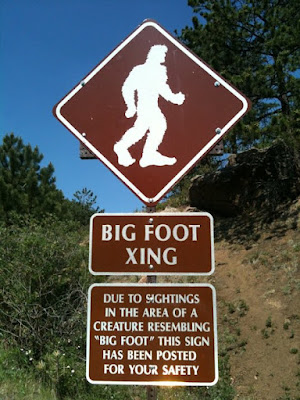
[Image licensed under the Creative Commons Gnashes30, Pikes peak highway big foot, CC BY-SA 3.0]

Coleman, of course, has devoted his entire life to hunting cryptids, so he's a classic example of the sunk-cost fallacy; once you have thrown enough of your time, energy, and money into something, it becomes nearly impossible for you to admit you were wrong.  So when Kathryn Skelton, reporter for the Sun Journal, asked Coleman point-blank why there's been no scientifically admissible evidence of Bigfoot despite thousands of people searching for him over the last hundred years, Coleman came up with an explanation that should go down in the annals of confirmation bias:

The problem is most of the cryptid hunters are male.

"I have a feeling that there’s something in the pheromones in males that are driving Bigfoot from them," Coleman said, apparently with a straight face, "and most of the success that’s occurring is with small groups of women that are having contact with no guns, maybe not even cameras, and really not getting all excited because they don’t find evidence right away.  Jane Goodall and every other primatologist that’s had success has been female, and I think that’s going to be the future."

So all those years I spent back-country camping in the Pacific Northwest, little did I know that I was chasing the Bigfoots away with my manly pheromones.

My reaction upon reading this was to say, "Oh, come on."  This kind of argument makes me want to take Ockham's Razor and slit my wrists with it.  It put me in mind of the old joke:

A guy has a friend who, every time he comes for a visit, tosses a pinch of glitter into the air and says, "May this house be safe from tigers."  After doing this a half-dozen times, the guy finally says to his friend, "Um... why are you saying, 'May this house be safe from tigers?'  There isn't a tiger within a thousand miles of here."

The friend gives him a serene smile and says, "Sure works well, doesn't it?"

Now, allow me to say that if any of the cryptids that people are out there searching for do turn out to be real, no one would be more delighted than me.  If there ever was incontrovertible proof of (for example) Bigfoot, the scientists would be trampling each other trying to be the first one to publish a paper about it.  So I'm not hostile to the idea per se, and neither, I suspect, are most scientists. 

But how long do you hold out in the face of exactly zero evidence?  And by "evidence" I don't mean eyewitness accounts, or even photos and videos.  Photos and videos are way too easy to fake, and to quote Neil deGrasse Tyson on the subject of eyewitness testimony, "In science, we need more than 'you saw it'...  The human brain and sensory systems are rife with ways of getting it wrong.  Now, maybe you did see something; if so, bring back a piece of evidence that can be studied in the lab.  Then we can have the conversation."

So as much as I understand Loren Coleman's reluctance to give up on his favorite topic, there comes a time when a skeptical person kind of has no choice.  And coming up with some loopy explanation that the Bigfoots are running away because of the researchers' testosterone fumes does not help your case -- or your credibility.

**************************************
Thursday, March 3, 2022

Return to sender

One of the hardest things about understanding quantum physics is that it is so fundamentally different from the way things act on the macroscopic level.

Even a layperson's grasp of the subject -- leaving aside all the abstruse mathematics -- requires one to jettison every expectation that the everyday objects we see and interact with will behave in the same fashion as the "objects" (as it were) on the subatomic level.  I put the word "objects" in quotes advisedly; the word "particle" brings to mind a hard, discrete little lump of matter, and that's still how they're drawn in science books:

[Image licensed under the Creative Commons Richie Bendall, Atomic structure of Lithium-7, CC BY-SA 4.0]

The reality is far weirder, and far harder to picture; particles, all the way down to photons of light, aren't little miniature bullets zinging around, they're actually smeared-out fields of probabilities.  The reassuringly solid matter we, and everything else, are made of turns out to be (at its basis) composed of something that is ephemeral, not even existing at one particular location in any real sense.

But it bears mention that however bizarre this is, it is not just a wild guess.  The predictions of quantum mechanics have been tested every which way from Sunday, and each time, the results have been spot-on.  So it may be unsettling, it certainly is counter-intuitive, but if we buy the methods of science at all, we have to conclude that whether we like it or not, this is what reality is.

Take, for example, the quantum boomerang effect, which I only found out about a couple of days ago because of some research out of the University of California - Santa Barbara.  The idea here, so far as I understand it -- and I will once again throw in the caveat that I'm not much better than a layperson myself, so bear with me -- has to do with what occurs when electrons in a substance are given a repeated kick of energy.

Picture, for example, something that spins freely on an axle, like a fan.  Imagine taking a fan (Nota bene: Mr. Safety says unplug it first!), and giving a regularly-timed tap on the blades with one finger.  The fan would absorb the energy, overcoming any resistance in the axle due to friction, and the blades would begin to turn; if you timed it right, you could get it spinning at a decent clip.

So far, nothing odd.  Now, imagine an analogous situation on the subatomic level.  Suppose you had a substance with atoms arranged in a lattice, but there are some defects in the lattice -- impurities, gaps, and so on.  In a metallic lattice, electrons are fairly free to move (this is why metals make good conductors); but the defects inhibit electron transfer, just as friction was working against you in turning the rotor blades.  Here, though, something completely different happens when you disturb the system.  If you give the lattice regular pulses of energy, the electrons are jolted out of their position, but they don't keep moving -- they immediately turn around and settle back down in their original positions.

Thus the nickname "the boomerang effect."

"It's really a fundamentally quantum mechanical effect," said physicist David Weld, who co-authored the paper, in an interview with Science Daily.  "There's no classical explanation for this phenomenon...  In a classical system, a rotor kicked in this way would respond by constantly absorbing energy from the kicks.  Take a quantum version of the same thing, and what you see is that it starts gaining energy at short times, but at some point it just stops and it never absorbs any more energy.  It becomes what's called a dynamically localized state."

The explanation, Weld says, lies in the dual particle-wave nature of subatomic particles.  Because matter on the smallest scales has both particle-like and wave-like properties, it's going to exhibit some weird properties as compared to the solid stuff we see around us.  "That chunk of stuff that you're pushing away is not only a particle, but it's also a wave, and that's a central concept of quantum mechanics," Weld said.  "Because of that wave-like nature, it's subject to interference, and that interference in this system turns out to stabilize a return and dwelling at the origin."

So we can add that to our list of weird and counterintuitive behavior on the quantum level.  The universe is a strange, compelling, beautiful place, and the more you study it, the stranger it gets.  Me, I kind of like that.  I don't mind that things aren't as they seem.  How boring things would be if our "common sense" got it right every single time.

Even if I don't fully understand it -- even if I never fully understand it -- I'd much prefer that the cosmos never loses its ability to astonish us.

**************************************

Wednesday, March 2, 2022

Weighty matter

Springboarding off yesterday's post, about a discovery of fossils that seem to have come from animals killed the day the Chicxulub Meteorite struck 66 million years ago, today we have a paper in arXiv that looks at why the meteorite hit in the first place.

When you're talking about an event that colossal, I suppose it's natural enough to cast about for a reason other than just shrugging and saying, "Shit happens."  But even allowing for that tendency, the solution landed upon by Leandros Perivolaropoulos, physicist at the University of Ioannina (Greece), seems pretty out there.

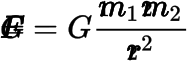
Perivolaropoulos attributes the meteorite strike to a sudden increase in Newton's gravitational constant, G -- the number that relates the ratio of the product of two masses and the square of the distance between them to the magnitude of the gravitational force:

F=G{\frac{m_1m_2}{r^2}}

The generally accepted value for G is 6.67430 x 10^-11 m^3 kg^-1 s^-2.  Being a constant, the assumption is that it's... constant.  And always has been.

Perivolaropoulos's hypothesis is that millions of years ago, there was a sudden jump in the value of G by about ten percent.  As you can tell from the above equation, if you keep the masses and the distance between them constant, F is directly proportional to G; if G increased by ten percent, so would the magnitude of the gravitational force.  His thought is that this spike in the attractive force caused the orbits of asteroids and comets to destabilize, and sent them hurtling in toward the inner Solar System.  The result: collisions that marked the violent, sudden end of the Mesozoic Era and the hegemony of the dinosaurs.

To be fair to Perivolaropoulos, his surmise is not just based on a single meteorite collision.  He claims that this increase in G could also resolve the "Hubble crisis" -- the fact that two different measures of the rate of the expansion of the universe generate different answers.  The first, using the cosmic microwave background radiation, comes up with a value of 67.8 kilometers/second/megaparsec; the second, from using "standard candles" like Cepheid variables and type 1A supernovas, comes up with 73.2.  (You can read an excellent summary of the dispute, and the current state of the research, here.)

[Image is in the Public Domain courtesy of NASA]

Perivolaropoulos says that his hypothesis takes care of both the Hubble crisis and the reason behind the end-Cretaceous meteorite collision in one fell swoop.

Okay, where to start?

There are a number of problems with this conjecture.  First -- what on earth (or off it) could cause a universe-wide alteration in one of the most fundamental physical constants?  Perivolaropoulos writes, "Physical mechanisms that could induce an ultra-late gravitational transition include a first order scalar tensor theory phase transition from an early false vacuum corresponding to the measured value of the cosmological constant to a new vacuum with lower or zero vacuum energy."  Put more simply, we're looking at a sudden phase shift in space/time, analogous to what happens when the temperature of water falls below 0 C and it suddenly begins to crystallize into ice.  But why?  What triggered it?

Second, if G did suddenly increase by ten percent, it would create some serious havoc in everything undergoing any sort of gravitational interaction.  I.e., everything.  Just to mention one example, the relationship between the mass of the Sun, the velocity of a planet, and the distance between the two is governed by the equation


So if the Earth (for example) experienced a sudden increase in the value of G, the radius of its orbit would (equally suddenly) decrease by ten percent.  Moving the Earth ten percent closer to the Sun would, of course, lead to an increase in temperature.  Oh, he says, but that actually happened; ten million years after the extinction of the dinosaurs we have the Paleocene-Eocene Thermal Maximum, when the temperatures went up by something like 7 C.  However, the PETM is sufficiently explained by a fast injection of five thousand gigatons of carbon dioxide into the atmosphere and oceans, likely triggered by massive volcanism in the North Atlantic Igneous Province -- and there's significant evidence of a carbon dioxide spike from stratigraphic evidence.  No need for the Earth to suddenly lurch closer to the Sun.

It wouldn't just affect orbits, of course.  Everything would suddenly weigh ten percent more.  It would take more energy to run, jump, even stand up.  Mountain building would slow down.  Anything in freefall -- from boulders in an avalanche to raindrops -- would accelerate faster.  Tidal fluctuations would decrease (although with the Moon now closer to the Earth, maybe that one would balance out).  

Also, if G did increase everywhere -- it's called the "universal gravitational constant," after all -- then the same thing would have happened simultaneously across the entire universe.  Then, for some reason, there was a commensurate decrease sometime between then and now, leveling G out at the value we now measure.  So we really need not one, but two, mysterious unexplained universal phase transitions, as if one weren't bad enough.

Then there's the issue that the discrepancy in the measurement in the Hubble constant isn't as big as all that -- it's only 3.4 sigma, not yet reaching the 5 sigma threshold that is the touchstone for results to be considered significant in (for example) particle physics.  Admittedly, 3.4 sigma isn't something we can simply ignore; it definitely deserves further research, and (hopefully) an explanation.  But explaining the Hubble constant measurement issue by appeal to an entirely different set of discrepant measurements that have way less experimental support seems like it's not solving anything, it's just moving the mystery onto even shakier ground.

Last, though, I come back to two of the fundamental rules of thumb in science; Ockham's razor (the explanation that adequately accounts for all the facts, and requires the fewest ad hoc assumptions, is most likely to be correct) and the ECREE principle (extraordinary claims require extraordinary evidence).  Perivolaropoulos's hypothesis not only blasts both of those to smithereens, it postulates a phenomenon that occurred once, millions of years ago, then mysteriously reversed itself, and along the way left behind no other significant evidence.

I hate to break out Wolfgang Pauli's acerbic quote again, but "This isn't even wrong."

Now, to be up front, I'm not a physicist.  I have a distantly-remembered B.S. in physics, which hardly qualifies me to evaluate an academic paper on the subject with anything like real rigor.  So if there are any physicists in the studio audience who disagree with my conclusions and want to weigh in, I'm happy to listen.  Maybe there's something going on here that favors Perivolaropoulos's hypothesis that I'm not seeing, and if so, I'll revise my understanding accordingly.

But until then, I think we have to mark the Hubble crisis as "unresolved" and the extinction of the dinosaurs as "really bad luck."

**************************************
Tuesday, March 1, 2022

Springtime collision

I've written here before about the rather sobering topic of mass extinctions, and from what reading I've done on the topic, it always leaves me thinking about how fragile Earth's ecosystems are.  Most of the biggest extinctions were not due to a single cause, though; for example, the Ordovician-Silurian extinction of about 445 million years ago seems to have been touched off by plate tectonics -- the massive southern continent of Gondwana meandered across the south pole, leading to ice cap formation, massive glaciation, and a drop in sea level.  However, there followed a huge drop in atmospheric oxygen and spike in sulfur, leading to worldwide oceanic anoxia.  The result: an estimate 60% mortality rate in species all over the Earth.

Anoxia is also thought to have played a role in the largest mass extinction ever, the Permian-Triassic extinction of 252 million years ago.  This one, however, seems to have begun with a catastrophic volcanic eruption that boosted the carbon dioxide in the atmosphere, and thus the temperature.  Temperature is inversely related to oxygen solubility, so as the oceans warmed, what oxygen was left in the air didn't dissolve as well, and nearly everything in the oceans died (a mortality rate estimated at an almost unimaginable 95%).  This caused an explosive growth in anaerobic bacteria, pumping both carbon dioxide and methane into the atmosphere.  The average temperature skyrocketed by as much as ten degrees Celsius.

Even the smaller extinctions seldom come from one cause.  I wrote recently about the Eocene-Oligocene extinction, which wiped out a good many of Africa's mammal species (our ancestors survived, fortunately for us), and was apparently an evil confluence of three unrelated events -- rapid cooling of the climate after the Paleocene-Eocene Thermal Maximum, a massive meteorite collision near what is now Chesapeake Bay, and explosive volcanism in Ethiopia.

The exception to the rule seems to be the most famous extinction of all, the Cretaceous-Tertiary extinction of 66 million years ago.  The one that ended the hegemony of the dinosaurs.  I always find it wryly amusing when the dinosaurs are described as some kind of evolutionary dead-end, as if their failure to survive to today is indicative that they were inferior or maladapted.  In fact, the dinosaurs as such were the dominant group of terrestrial animals for almost two hundred million years -- from the late Permian to the end of the Cretaceous -- and that's not counting birds, which are (frankly) dinosaurs, too.  That means if you consider the earliest modern humans to have lived in Africa on the order of three hundred thousand years ago, the dinosaurs kind of ran the planet for over six hundred times longer than we've even existed.

And in the blink of an eye, everything changed.  Far from being an evolutionary cul-de-sac, the dinosaurs were doing just fine, when a meteor ten kilometers in diameter slammed into the Earth near what is now the Yucatán Peninsula of Mexico.  And now scientists have been able to pinpoint not only where the collision happened, but what time of year -- the middle of the Northern Hemisphere's spring.

The Chicxulub Impact, as visualized by artist Donald E. Davis [image is in the Public Domain courtesy of NASA]

Paleontologists working in North Dakota have found a rich fossil site that was created on that fateful day.  Pre-collision, the area was a wet lowland forest with a shallow river.  The slow-moving water was the home of paddlefish and sturgeon, swimming slowly and nosing around in the mud for food.  Then, three thousand kilometers away, the meteor struck.  The shock wave ejected a sheet of superheated steam and molten rock skyward; the impact, which occurred in what was (and still is) a shallow marine region, generated a tsunami the likes of which I can't even imagine.  The southern part of North America got flash-fried by the heat generated by the strike; only a few minutes later, it was followed by a wall of water the height of a skyscraper that swept across the land at an estimated five hundred kilometers an hour.

The first thing the fish would have noticed, though, is a rain of tiny globs of molten glass that sizzled as they hit the water and settled out, coating the riverbed and clogging their gills.  Then the tsunami hit, burying the site under thick layers of sediment.  By the time things calmed down, most of the living things in North America were dead, their fossils left behind as a near-instantaneous photograph of one of the worst days the Earth has ever seen.

It's the quickness of the event that allowed scientists to figure out when it happened.  Paddlefish bones form growth layers -- a little like the rings inside a tree trunk -- and all of the paddlefish fossils from the site show an increasing rate of growth, but not yet at its annual peak (which occurs in the warmest parts of summer).  The Chicxulub meteorite seems to have struck the Earth in April or May.

This may be another reason why the Northern Hemisphere flora and fauna took a much bigger hit than the ones in the Southern Hemisphere.  The initial explanation was that the meteor struck the Earth at an angle, on with a trajectory on the order of forty-five degrees south of vertical, so the shower of molten debris mostly got blasted northward.  (This may well be true; the current research doesn't contradict that assessment.)  But if the strike occurred in the Northern Hemisphere's spring, when plants are leafing out and flowering, and animals increasing in activity, it would have been catastrophic.  The ones in the Southern Hemisphere, heading into fall and winter, would have been in the process of powering down and moving toward dormancy and hibernation, and may have been more insulated from the effects.

Besides the obvious fascination of an event so cataclysmic, it's just stupendous that we can analyze the evidence so finely that we can determine what time of year it occurred, 66 million years later.  It also highlights how suddenly things can change.  The dinosaurs had been around for two hundred million years, surviving not only the colossal Permian-Triassic extinction but the smaller (but still huge) end-Triassic extinction, that took out thirty percent of the species on Earth.  In one particular April of 66 million years ago, a quick look around would have led you to believe that everything was fine, and that the dinosaurs and other Mesozoic critters weren't going anywhere.

A day later, the entire face of the Earth had changed forever.

**************************************

Monday, February 28, 2022

"Gotcha" proselytizing

A frequent reader and commenter on Skeptophilia sent me a note a few days ago, with a link and the cryptic comment, "Gordon, I think you need to take a look at this."  At first, I thought the link was to my own website -- but underneath the link was an explanation that the individual had discovered the link by accidentally mistyping the website address as skeptophilia.blogpsot.com.  (Bet it took you a while to figure out the misspelling, didn't it?  It did me.)

So, anyway, I clicked on the link, and was brought here.

To say that I found this a little alarming was an understatement.  Had someone gone to the lengths of purchasing a website name one letter off from mine, to catch off guard the unwary (and possibly uneasy) skeptics and agnostics who thought they were going to visit a site devoted to rationalism?  I've been the target of negative comments before, from angry believers in everything from homeopathy to hauntings, and certainly have gotten my share of hate mail from the vehemently religious contingent who are bothered by the fact that I am an atheist who is completely, and confidently, "out," and am an unapologetic defender of the evolutionary model, Big Bang cosmology, and so on.  But this seemed kind of out there even for those folks.

Fortunately, my wife, who is blessed with a better-than-her-fair-share amount of common sense and a good grounding in technology, suggested that I try to type in SomethingElse.blogpsot.com.  So I did.  I first tried the address for a friend's blog, but put in the deliberate misspelling for "blogspot."  It brought me to the same place.  Then I tried "CreationismIsNonsense.blogpsot.com."  Same thing.

So apparently, the owner of this ultra-fundamentalist website, with its babble about the Rapture and Armageddon and the literal truth of the Bible, had just bought the domain name "blogpsot.com," so that any time anyone makes that particular misspelling in heading to their favorite blog, it takes them to that site.  I was relieved, actually; the thought that someone would go to all that trouble to target me in particular was a little unnerving.  (And evidently the fact that on the homepage of the "blogpsot" site, there is a link for "The World's Biggest Skeptic" is just a coincidence.)

However, you have to wonder if the person who owns the site really is laboring under the mistaken impression that this is an effective proselytizing tool.  Can you really imagine someone who is trying to check out the latest post on his/her favorite blog on, say, sewing, and lands here -- and then suddenly goes all glassy-eyed, and says, "Good heavens. I get it now.  The Bible is true, the Rapture is coming, and I'd better repent right now."

No, neither can I.

And when you think about it, the door-to-door religion salesmen that periodically show up in our neighborhoods are the same kind of thing, aren't they?  A little less covert and sneaky, that's all.  But they're trying to accomplish the same goal -- catching you off guard, getting a foot in the door, spreading the message.

Of course, that approach sometimes backfires.  A couple of years ago a pair of missionaries (Jehovah's Witnesses, if I recall correctly) came up to my front door.  They were both women, the older maybe forty and the younger looking like she was in her twenties.  Both of them were immaculately attired in modest dresses and starched white blouses.  They didn't see that I was working in the garden; I was kind of hidden behind a bush I was pruning.  It was a blistering hot day, and when I heard the knock I walked over to them -- shirtless, covered in grime and sweat.  I acted completely nonchalant, but they were clearly uncomfortable.  The usual spiel was seriously truncated, and they made an excuse to leave after five minutes or so despite my rather over-the-top friendliness.

I gave them a big wave when they left and told them to drop in any time.

Never saw them again.  I guess God's only interested in converts who are clean and fully clothed.

Franciscan missionaries in California (woodcut from Zephyrin Engelhardt's Mission San Juan Capistrano: A Pocket Guide, 1922) [Image is in the Public Domain]

In any case, my previous comment about this sort of thing being an ineffective proselytizing tool is irrelevant, really.  It's like spam emails.  If you send out a million emails, and your success rate is 0.1%, you've still made money, because of the extremely low overhead.  Same here; you get volunteers (in the case of the door-to-door folks) or unsuspecting drop-ins (in the case of the website).  Most of the target individuals say no, or hit the "Back" button -- but the fraction of a percent that don't are your payoff.

The whole thing pisses me off, frankly, because it's so sneaky.  Even if it wasn't targeted at me specifically, it just seems like a skeevy way to get converts.  But to a lot of these folks, how you convert people is unimportant.  The essential thing is to convert them in the first place.  If you can grab people when their rational faculties are not expecting it, all the better -- because, after all, rationality is the last thing they want to engage.

**************************************

Saturday, February 26, 2022

Unity in diversity

It was in my evolutionary biology class in college that I ran into a concept that blew my mind, and in many ways still does.

It was the idea that race is primarily a cultural feature, not a biological or genetic one.  There is more genetic diversity amongst the people of sub-Saharan Africa -- people who many of us would lump together as "Black" -- than there is in the rest of the world combined.  A typical person of western European descent is, our professor told us, closer genetically to a person from Japan than a Tswana man is to the !Kung woman he lives right next door to in Botswana, even though both have dark skin and generally "African features."


To reiterate: I'm not saying race doesn't exist.  It certainly does, and the social, cultural, and political ramifications are abundantly clear.  It's just that what we often think of as race has very close to zero genetic support; we base our racial classifications on a handful of characteristics like skin and eye color, the shape of the nose and mouth, and the color and texture of the hair, all of which can so easily undergo convergent evolution that it triggers us to lump together very distantly-related groups and split ones that lie much closer together on the family tree.

The reason this comes up today is a couple of bits of recent research highlighting the fact that the subject is way more complicated than it seems at first.  The first looks at the fragmentation that happened in Africa, on the order of twenty thousand years ago, that resulted in the enormous genetic diversity still to be found in sub-Saharan Africa today.  By analyzing DNA from both living individuals and the remains of people from long ago, researchers at Harvard University found that this was about the time that our ancestors stopped (for the most part) making extended walkabouts to find mates, and settled into being homebodies.  What triggered this is a matter of conjecture; one possibility is that this was in the middle of the last ice age, it could be that the colder and drier conditions (even in equatorial regions) made food scarcer, so long trips into unknown territory were fraught with more danger than usual.

Whatever the cause, the isolation led to genetic drift.  A general rule of evolutionary biology is that if you prevent genetic mixing, populations will diverge because of the accrual of random mutations, and that seems to be what happened here.  The fact that a Tswana person and a !Kung person (to use my earlier example) are so distinct is because they've been genetically isolated for a very long time -- something facilitated by a tendency to stay at home and partner with the people you've known all your life.

Interestingly, some research last year suggested that there are "ghost lineages" in the human ancestry -- groups that are ancestral to at least some modern humans, but are as yet unidentified from the fossil record.  The one studied in last year's paper were ancestral to the Yoruba and Mende people of west Africa, in which between two and nineteen percent of the genomes come from this ghost lineage -- but the phenomenon isn't limited to them.  The authors found analogous (but different) traces of ghost lineages in people of northern and western European and Han Chinese descent, and the guess is that all human groups have mysterious, unidentified ancestral groups.

The other bit of research that was published last week was an exhaustive study of the genetics of people around the world, with an ambitious goal -- coming up with a genetic family tree for every group of people on Earth. "We have basically built a huge family tree, a genealogy for all of humanity that models as exactly as we can the history that generated all the genetic variation we find in humans today," said Yan Wong of the University of Oxford, who co-authored the study.  "This genealogy allows us to see how every person's genetic sequence relates to every other, along all the points of the genome."

The researchers analyzed 3,609 individual DNA samples representing 215 different ethnic groups, and used software to compare various stretches of the DNA and assemble them using the technique called parsimony -- basically, creating a family tree that requires the fewest random coincidences and ad hoc assumptions.  The result was an enormous genealogy containing 27 million reconstructed common ancestors.  They then linked location data to the DNA samples -- and the program identified not only when the common ancestors probably lived, but where they lived.

I find this absolutely amazing.  Using modern genetic analysis techniques, we can assemble our own family tree, with roots extending backwards tens of thousands of years and encompassing lineages for which we have no archaeological or paleontological records.  With the number of connections the research generated, I have no doubt we'll be studying it for years to come, and have only started to uncover the surprises it contains.

But all part of living up to the maxim inscribed in the Temple of Apollo at Delphi -- γνῶθι σεαυτόν.

"Know thyself."

**************************************