Skeptophilia (skep-to-fil-i-a) (n.) - the love of logical thought, skepticism, and thinking critically. Being an exploration of the applications of skeptical thinking to the world at large, with periodic excursions into linguistics, music, politics, cryptozoology, and why people keep seeing the face of Jesus on grilled cheese sandwiches.

Tuesday, March 22, 2022

The painted bones

It's fascinating how long into our past we've had rituals surrounding death.

There's decent evidence that our cousins the Neanderthals -- which went extinct on the order of forty thousand years ago -- buried their dead, and used ceremonial pigments like red and yellow ochre to decorate the bodies.  What I'm curious about is if those rituals were performed purely as fond remembrance of the the person who had died, or if it had a more religious significance.  Did they believe in an afterlife?  Was the reverence shown to a dead person's body because of belief that the person's soul still, in some sense, inhabited the remains?  Or some other reason entirely?  

It's all too easy to misinterpret the tangible evidence left behind, even from the relatively recent past.  Take, for example, the practice -- most common in Scotland and England -- of placing sturdy metal cages over grave sites.  The more fanciful-thinking believe it was because of a fear of vampires or zombies -- to protect the living from the dead.

A "mortsafe" in Cluny, Aberdeenshire, Scotland

The real reason -- which we know from the writings of the time -- was that it was actually to protect the dead from the living.  Grave robbing was common in the seventeenth and eighteenth centuries, not only to steal any valuables the person might have been buried with, but to sell the corpse itself to medical or anatomical laboratories for dissection.  (Recall the early nineteenth century Burke and Hare murders, where a pair of enterprising young men decided it was more lucrative to kill people themselves and sell their bodies than to wait for them to die; Hare turned King's evidence in exchange for immunity if he testified against Burke, which he did.  Burke was hanged -- and in a grisly but ironic twist, his body was given to an anatomical laboratory for dissection.)

So it's harder than you'd think to ascertain the motives people had for certain ritual practices in the past.  As far as the decoration of bodies by the Neanderthals, of course, at this point it's impossible to know.  But it's fascinating that our (very) distant ancestors had burial rituals not so very different from our own.

A recent find in Turkey has shown that modern humans have been doing this sort of thing for a very long time as well.  Çatalhöyük, nicknamed the "oldest city in the world," has provided fascinating archaeological finds before; the "Mother Goddess of Çatalhöyük," a six-thousand-year-old ceramic statue probably associated with rituals of fertility (sex being the other thing people have been obsessed with for a long time) is probably the most famous artifact from the site.  (If you're wondering how Çatalhöyük is pronounced -- heaven knows I was -- I'll save you the trouble.  Near as I can get, it's something like "chot-al-hoik.")

[Image is licensed under the Creative Commons Nevit Dilmen, Museum of Anatolian Civilizations 1320259 nevit, CC BY-SA 3.0]

A new find at the site, though, is equally interesting.  A team from the University of Bern has uncovered nine-thousand-year-old bones -- so a full thousand years older than the Mother Goddess figurine -- that show evidence of having been painted.  Not only were they painted, they appear to have been unearthed more than once, and repainted.  Fascinatingly, they used different colors for different genders -- cinnabar/red for males, copper-bearing minerals/blue and green for females.  Not all the bones were so decorated; it may have been a mark of status, or membership in a ruling class or priestly class, but all that is speculation.  (The fact that there have been painted bones of children found suggests that it wasn't mere individual status that was the deciding factor.)

There's also an association between the number of painted burials in a building, and the amount of painted decoration on the walls.  "This means when they buried someone, they also painted on the walls of the house," said study senior author Marco Milella.  "Furthermore, at Çatalhöyük, some individuals stayed in the community: their skeletal elements were retrieved and circulated for some time, before they were buried again.  This second burial of skeletal elements was also accompanied by wall paintings."

I'd like to think that the painted bones were a sign of reverence and not fear of retaliation by an angry spirit, but that too is speculation.  All we have is the artifacts to judge by.  Even so, it's fascinating to get a glimpse into the distant past of our own species.

And you have to wonder what our distant descendants will make of the artifacts left from our own society.  What will they think of the marble and granite monuments we raised over the dead?  It puts me in mind of the eerie, atmospheric rhyme I saw on a gravestone in the cemetery in Waynesburg, Pennsylvania where my great- and great-great grandparents are buried:

Remember, traveler, as you pass by,
As you are now, so once was I;
As I am now, so you will be;
Prepare for death, and follow me.

**************************************

Monday, March 21, 2022

Dowsing for corpses

Back when I was teaching, I ran into students with a lot of fringe-y beliefs, or at least unscientific ones.  But if you had to pick which one students were the most reluctant to abandon, I bet you'd never guess.

Dowsing.

Dowsing, also called water-witching, is the belief that you can use a forked stick (more modern dowsers use a pair of metal rods on a swivel) to locate stuff.  It started out being used to find underground water for a well (thus the appellation "water-witching"), but has since progressed (or regressed?  Guess it depends upon your viewpoint) to being used to find all sorts of things, including -- I kid you not -- marijuana in kids' lockers in a high school.

"But it works!" students said, when I told them there was no scientific basis for it whatsoever.  "My dad hired a guy to come tell us where to dig our well, and we hit water at only thirty feet down!"

Yeah, okay.  But this is upstate New York, one of the cloudiest, rainiest climates in the United States.  Unless you're standing on an outcropping of bedrock, there's gonna be groundwater underneath you.  In fact, only about twenty miles from here, there's a hillside with a natural artesian spring -- someone put a pipe into it, and people stop and fill up water bottles from the clear water gushing out.  So it's entirely unsurprising that you hit water where the dowsing guy indicated.  You'll hit water pretty much anywhere around here if you dig down a ways.

[Image is in the Public Domain]

What's funniest are the quasi-scientific explanations the dowsers give as to why it (allegedly) works.  An example is that you should always make your dowsing rod from a willow branch, because willows grow near water, so the wood remains attracted to it.  Even though I'm yet to see how a dead branch could respond that way.  Or any way, honestly.

Given that it's dead.

Every scientifically-valid study of dowsing has resulted in zero evidence that it works.  This doesn't mean the dowsers are deliberately cheating; they may honestly think the stick is moving on its own.  This is called the ideomotor effect, where small movements made unconsciously by the practitioner convince him/her (and the audience) that something real, and supernatural, is going on.  (The same phenomenon almost certainly accounts for spiritualist claims like Ouija board divination and table-turning.)

But despite these sorts of arguments, I fear that I convinced few students to change their beliefs.  "I saw it happen!" is a remarkably powerful mindset, even once you accept that we're all prone to biases, and that we're all easily fooled when it comes to something we want to believe.

So this is why I was unsurprised but disheartened to read an article from Mother Jones sent to me by a long-time loyal reader of Skeptophilia.  In it, we read about one Arpad Vass, a guy who believes that you can use dowsing rods...

... to find dead bodies.

This would just be another goofy belief, and heaven knows those are a dime a dozen, but he has somehow convinced the people who run the National Forensic Academy in Oak Ridge, Tennessee that his technique is scientifically sound.  He has some kind of cockeyed explanation of how it works -- that the effect is due to piezoelectricity, a phenomenon where certain crystalline substances develop a charge when they're subjected to mechanical stress.  Piezoelectricity is real enough; it's the basis of quartz watches, inkjet printing, and electric guitar pickups.  But even if decomposing bone can generate some net static charge, it would leak away into the soil it's buried in -- there's no mechanism by which it could exert a pull on some bent wires several meters away.  (Actually, Vass claims he's successfully found corpses this way from a hundred meters away.  If the static charge is that high, you shouldn't need a dowsing rod to detect it -- a plain old boring volt meter would work.  Funny how that never happens.)

And, of course, there's the problem that it doesn't work for everyone.  Vass has an answer for that, too.  "If people don’t have the right voltage, it’s not going to work," he says.  "Everything in the universe vibrates at a very specific frequency.  Gold has a gold frequency, silver has a silver frequency, and your DNA has your frequency."

I guess bullshit has a specific frequency, too.

The problem is that Vass isn't just playing around, or doing something that isn't a huge deal if it doesn't work (like finding a well drilling site).  This is injecting pseudoscience into police investigation.  And recently, he's gone one step further; he has invented, he said, a "quantum oscillator" that supposedly picks up a person's "frequency" from something like a hair sample or fingernail clippings, and then beams that frequency out, and it will somehow interact with the person (or his/her corpse), and send back a signal to the device...

... from up to 120 kilometers away.

I was encouraged by the fact that the Mother Jones article came down fairly solidly on the side of the scientists, stating unequivocally that there is no evidence that any form of dowsing works.  They also highlighted the human side of this; Randy Shrewsberry, founder of the nonprofit Criminal Justice Training Reform Institute, was quoted as saying "Law enforcement regularly accepts the flaws of these practices despite the life-altering impacts that can occur when they’re wrong."  In one Virginia case, a man was convicted of murder even though no body of the victim was found -- in part, because of testimony from Vass that his device had found the victim's "frequency" in eight locations, indicating that her body had been dismembered.

Eric Bartelink, professor of anthropology at the University of California - Chico and former president of the American Board of Forensic Anthropology, was unequivocal.  "Vass is operating these services that are not scientifically valid.  It’s very misleading to families and law enforcement."

So at least some prominent voices in the field are speaking up to support the findings of every scientific study ever done on the practice of dowsing.  I'm still appalled that a forensic training academy has somehow been convinced to take Vass and his nonsense seriously; I guess being highly educated isn't necessarily an immunization against confirmation bias.  As for me, I'm calling bullshit on the whole practice.

Beam that into your "quantum oscillator," buddy.

**************************************

Saturday, March 19, 2022

The imaginary fireball

The subject of today's post isn't anything new; it was just new to me, and, I suspect, will be to a good many of my readers, as well.  I found out about it from a long-time loyal reader of Skeptophilia, who sent me a link about it with a note saying, "Okay, this is interesting. What think you?"

The link was to a 2008 article that appeared in Phys.org entitled, "Cuneiform Clay Tablet Translated for the First Time."   The tablet in question is called the "Sumerian planisphere," and was discovered in the ruins of Nineveh by a British archaeologist named Henry Layard in the middle of the nineteenth century.  From where it was found, it was dated to around 700 B.C.E., and although it was recognized that part of what it contained was maps of constellations, no one was quite sure what it was about.

The Sumerian planisphere [Image is in the Public Domain]

The researchers were puzzled by the fact that the arrangements of the stars in the constellations were close to, but not exactly the same as, the configurations they would have had at the time it was made, but then they concluded that those would have been their positions 2,400 years earlier -- and they claimed the text and maps didn't just show the stars on any old night, but on a sequence of nights chronicling the approach of a comet or asteroid.

Which, ultimately, hit the Earth.

They claim the collision site was near Köfels, Austria, and triggered a five-kilometer-wide fireball.  Why no huge crater, then?  The answer, they say, is that the steep side of the mountain gave way because of the impact, and a landslide ensued.  Organic matter trapped in the debris flow gave an approximate date, but once deciphered, the Sumerian planisphere's detailed sky maps (including the position of the Sun, the timing of sunrise, and so on) supposedly pinpointed the exact day of the impact: the 29th of June, 3123 B.C.E.

Between the planisphere and the geometry of the collision site, the researchers claimed that the comet came in at a very shallow angle -- their estimate is about six degrees -- clipped the nearby peak of Gamskogel, and exploded, creating a five-kilometer-wide moving fireball that finally slammed into Kófels head-on.

You may be wondering why Sumerian astronomers had any particular interest about an impact that occurred almost four thousand kilometers away.  They have an answer for that, too; the shallow impact angle created a sheet of superheated debris that arced away from the impact site, and right toward what is now the Middle East.  A 2014 paper by Joachim Seifert and Frank Lemke concluded that the greatest amount of damage didn't occur right at the collision site, but where all that flaming debris eventually landed -- in Mesopotamia.

"The back plume from the explosion (the mushroom cloud) would be bent over the Mediterranean Sea re-entering the atmosphere over the Levant, Sinai, and Northern Egypt," said Mark Hempsell of the University of Bristol, who is the chief proponent of the Köfels collision hypothesis.  "The ground heating though very short would be enough to ignite any flammable material - including human hair and clothes.  It is probable more people died under the plume than in the Alps due to the impact blast."

The dust and ash from the event caused a hundred-year-long "impact winter" that triggered droughts, leading to a several-centuries-long famine that ultimately caused the collapse of the Akkadian Empire.

Okay, so that's the claim.  There are, unfortunately, a host of problems with it, beginning with those pointed out by the scathing rebuttal by Jeff Medkeff in Blue Collar Scientist.  The first issue is that there is "impact glass" -- vitrified shards of debris partially melted by a collision -- in central Europe, but it dates to much longer ago (certainly more than eight thousand years ago).  There is no impact debris to be found between central Europe and the Middle East anywhere near 3,100 B.C.E., no scorched pottery shards or charred bones that would be indicative of a rain of fire.  An asteroid or comet "clipping" a mountain -- and then generating a plume of debris that was still superheated four thousand kilometers downstream -- would have sheared off the entire mountain top, and there'd be clear evidence of it today.  Last -- and most damning -- the Köfels formation has been studied by geologists and found to be not a single event, but a series of landslides, none of which show convincing evidence of having been triggered by an impact.

The scientists involved don't even seem sure of their own chronology; the Phys.org article says 3123 B.C.E. (the 29th of June, to be exact), while the Seifert and Lemke paper says the impact occurred almost a thousand years later (in 2193 B.C.E.).  The latter date at least is closer to the claimed civilization-destroying effects; the Akkadian Empire fell in around 2154.  It seems likely, though, that the collapse of the Akkadians (and various others, including the Indus Valley Civilization, the Egyptian Old Kingdom, and the Chinese Liangzhu Culture) was due to a drought called the "4.2 Kiloyear Event."  The cause of that is uncertain, but probably wasn't an impact (again, because of the lack of clear stratigraphic evidence).  The most likely culprit was a shift in cold-water currents in the North Atlantic changing patterns of rainfall, but even that is speculative.

As far as Hempsell's even more outlandish claim -- that the Köfels impact generated the story of the destruction of Sodom and Gomorrah -- I won't even go into details except to say that there is evidence of a much smaller airburst explosion where the cities were allegedly located, but once again, it's from a different date (around 1650 B.C.E.).  As for any other evidence of the biblical "Cities on the Plain," it's slim to nonexistent.  Archaeologist Israel Finkelstein, of Tel Aviv University, called the tale of the destruction of Sodom and Gomorrah "an etiological story, that is, a legend that developed in order to explain a landmark.  In other words, people who lived in the later phase of the Iron Age, the later days of the kingdom of Judah, were familiar with the huge ruins of the Early Bronze cities and told a story of how such important places could be destroyed."

So given the (1) lack of any reasonably reliable evidence, (2) a chronology that even the researchers don't seem to be able to keep straight, and (3) plausible alternative explanations for the supposed societal aftereffects, I'm afraid I'm gonna be in the "don't think so" column on this one.  As dramatic as it would be if the astronomers of Sumer documented the approach and ultimate collision of a comet or asteroid, a collision that ultimately showered flaming debris over the entire Middle East, I think we have to set aside the drama of an imaginary fireball for the cold light of reason.

**************************************

Friday, March 18, 2022

Birds of a feather

I should probably avoid social media altogether, given what a cesspit of ugliness it can be sometimes.

Unfortunately, it's provided the simplest way of keeping in touch with dear friends I seldom see, especially during the height of the pandemic (when I kind of wasn't seeing anyone).  But to say it amplifies the echo chamber effect is an understatement.  Not only do we tend to link on social media to like-minded folks (can't tell you how many times I've heard someone say that they'd unfriended someone solely because of some opinion or another, usually political), but with the few non-like-minded social media friends we have and keep, it takes so much energy to argue that most of us just sigh heavily, shrug our shoulders, and move on, even when confronted with opinions completely antithetical to our own.

Take, for example, what I saw posted yesterday -- a meme saying, "All I'm saying is, if my dog got three rabies shots and then still got rabies, I'd begin to get suspicious."  (It took all my willpower not to respond, "Oh, how I wish that was all you were saying.")  In any case, not only does the post trumpet zero understanding about how vaccinations and immunity work, it's back to the maddening phenomenon of a layperson thinking an opinion formed from watching Fox News and doing a ten-minute read of some guy's website constitutes "research."


If that wasn't bad enough, a friend-of-the-friend -- no one I know -- responded, "It's what comes from drinking the libtard kool-aid."  So, let's take the ignorant post and make it worse by slathering on some ugly vitriol demeaning half the residents of the country.

And what did I do in response?

Nothing.

I just didn't have the energy to get drawn in.  Plus, there's a sense of such argument being futile anyhow.  I seriously doubt anyone, in the history of the internet, has ever had their opinion changed by arguing a point online with a total stranger.

Only a few minutes after seeing the post, though, I stumbled on some research out of the University of Buffalo that contains at least a glimmer of hope; that the screeching you hear on social media isn't necessarily reflective of the attitudes that the majority of people have, because these platforms amplify the loudest voices -- not necessarily the ones that make the best sense, or are even the most common.

In a paper in The Journal of Computer-Mediated Communication, Yini Zhang, Fan Chen, and Karl Rohe looked at our tendency to form "flocks" on social media.  By studying the posts from 193,000 Twitter accounts, and the 1.3 million accounts those accounts follow, they were able to uncover patterns of tweets and retweets, and found the strongest-worded opinions were the ones that got liked and retweeted the most.  They called this phenomenon murmuration -- the term comes from the flocking behavior of starlings -- capturing the idea that online expression of opinions forms and shifts not based on actual changes in the information available, but on who is saying what, and how stridently.

"By identifying different flocks and examining the intensity, temporal pattern and content of their expression, we can gain deeper insights far beyond where liberals and conservatives stand on a certain issue," said study lead author Yini Zhang, in an interview in Science Daily.  "These flocks are segments of the population, defined not by demographic variables of questionable salience, like white women aged 18-29, but by their online connections and response to events.  As such, we can observe opinion variations within an ideological camp and opinions of people that might not be typically assumed to have an opinion on certain issues.  We see the flocks as naturally occurring, responding to things as they happen, in ways that take a conversational element into consideration."

The fact that the social media flocking doesn't mirror the range of opinion out there is heartening, to say the least.  "[S]ocial media public opinion is twice removed from the general public opinion measured by surveys," Zhang said.  "First, not everyone uses social media.  Second, among those who do, only a subset of them actually express opinions on social media.  They tend to be strongly opinionated and thus more willing to express their views publicly."

It's not just political discourse that can be volatile.  A friend of mine just got blasted on Facebook a couple of days ago, out of the blue, because she posts stuff intended to be inspirational or uplifting, and one of her Facebook friends accused her of being "self-righteous," and went on to lambaste her for her alleged holier-than-thou attitude.  The individual in question doesn't have a self-righteous bone in her whole body -- she might be the only person I know who has more of a tendency to anxious self-doubt than I do -- so it was a ridiculous accusation.  But it does exemplify the sad fact that a lot of us feel freer to be unkind to people online than we ever would face-to-face.  

The important point here is that it's easy to see the nastiness and foolishness on social media and conclude that this is the way the majority of the public believes and acts, but the Zhang et al. study suggests that the majority of the opinions of this sort are generated by a few strident people.  Only afterward do those posts act like a magnet to the like-minded followers they already had.

So as hard as it is to keep in mind sometimes, I maintain that the majority of people are actually quite nice, and want the same things we want -- safety, security, the basic necessities, health and happiness for our friends and family.  The ugly invective from people like the guy who made the "libtard" comment is far from a majority opinion, and shouldn't feed into a despairing sense that everyone is horrible.

The flocks, apparently, aren't led by the smartest birds, just the ones who squawk the loudest.  A lot of the rest are tagging along for the ride.  There's a broader population at the center, opinion-wise, than you'd think, judging by what you see on social media.  And when the birds step away from social media, most of them turn out to be ordinary tweeters just trying to stay with the flock-mates they feel the most comfortable with.

**************************************

Thursday, March 17, 2022

Alchemy class

Frequently, when I'm asked why I'm opposed to science teachers being required to teach "alternate explanations" along with teaching evolution, I respond, "It's interesting that no one is asking teachers to present 'alternate explanations' in other areas of science.  No one, for example, expects chemistry teachers to advocate alchemy as an 'alternate explanation.'"

By now, you'd think I'd know better than to use the phrase "no one" in a statement about belief in some crackpot idea.

Meet Jay Weidner, film director responsible for such masterpieces as Timewave 2013, Infinity: The Ultimate Trip, and (most significantly, for our purposes) The Secrets of Alchemy: The Great Cross and the End of Time.  On his website, Weidner outlines his three laws of the universe, which are poised to oust Newton's Laws as fundamental rules governing nature:
  • Weidner's First Law: "Whatever ideas are the most suppressed are the most likely to be the closest to the truth."
  • Weidner's Second Law: "If a picture is worth a thousand words, then a symbol is worth a thousand pictures."
  • Weidner's Third Law: "The only people who call conspiracies 'theories' are the conspirators."
The First Law would seem to suggest that we should go back the Four Humors Theory of Medicine (all illnesses are caused by an imbalance between the Four Bodily Humors -- blood, phlegm, yellow bile, and black bile), as that was suppressed back when they noticed that patients treated according to the recommendations of this theory usually died.  The Second Law means -- never mind, I don't know what the fuck the Second Law means.  But the Third Law would seem to indicate that I'm a conspirator.  I guess that given that I call most conspiracies "theories," and worse still, ridicule them frequently in my blog, I'm not only a conspirator, but I'm really high up in the hierarchy of the conspiracy because I'm so determined to convince everyone that it isn't real.

How about that?  I'm in such a high echelon in a top-secret conspiracy that the fact was secret even from me.  Now that's what I call a secret conspiracy.

In any case, Weidner is a big believer in alchemy, especially as it pertains to the production of the Philosopher's Stone, a substance that can give eternal life.  I thought that Dumbledore had destroyed the Philosopher's Stone way back in the first book of Harry Potter, but Weidner disagrees; he said he has discovered a book that shows you how to produce it, using "materials costing less than a thousand dollars," and he illustrates this on his website using a picture of Aquarius, symbolized by a guy with a Fabio hairstyle, huge pecs and biceps, a six-pack, and almost no clothes, pouring water out of a jar, wearing an expression that seems to say, "Hey, baby, you wanna partake of my Elixir of Life?"

Now there's a symbol that's worth a thousand pictures.


Anyway, the book that describes the process for making the Philosopher's Stone is available for free here.  Weidner cautions us all to download the book before the Evil Conspirators find out that it's available and "hit the internet kill switch."  Because we all know how much the people who run the internet care about the presence of wacky, absurd ideas out there online.  We can't have that.

Curious, I took a look at the book (The Book of Aquarius), since it's free.  When you go to the "Read Online" page, you get a set of chapter headings, and not wanting to slog through the pages of quasi-metaphysical bullshit, I decided to cut to the chase, and skipped to Chapter 14: What Is It Made Of?  And I found out that, to my great shock, the Philosopher's Stone is only made from one ingredient.  And that ingredient is...

... wait for it...

Urine.

Yes, you read that right.  I know, because I had to read it several times before I was convinced that I was reading it correctly myself.  And I thought, "Well, at least Weidner was right when he said that you can get the ingredients for less than a thousand dollars."  Here's the relevant passage from the book:
I must explain that the Stone could in theory be made from anything, since everything contains the life-energy to some degree, which is the active ingredient of the Stone.  Urine contains this life-energy in high concentration, due to the fact that it has just come out of you, and you, as a living animal, are full of life-energy...  From the urine we will need to extract a distillate (water) and a salt.  The life-energy is in the water, and since the life-energy is so volatile it will remain with the water even when the water is distilled (evaporated and condensed).  Our bodies do not want to reject the life-energy in the urine, but have no choice since the life-energy is attached to the water.  Secondly, urine is the perfect ingredient because it is as of yet undetermined.  That is, it has been well filtered, broken down and purified.  It contains all kinds of different minerals, but in minute particles not yet assigned to any purpose.
At this point, I had to stop reading, mostly because it's hard to read the computer screen when your forehead is on your desk.

Anyhow, I encourage you to peruse Weidner's site (I especially recommend the stuff about Stanley Kubrick faking the moon landing) and The Book of Aquarius.  But if you succeed in making the Philosopher's Stone, please don't tell me about it.  I don't want to know.  For one thing, it will mean that you'll have been playing around with your own urine, or, god forbid, someone else's, and that's just nasty.  For another, at that point you'll have discovered the Secret of Eternal Life, and being that I'm one of the Conspirators, I'd be duty-bound to kill you.  That'd just be unfortunate for a variety of reasons, the most important one of which is that I need all the readers I can get, and if I went around killing them it might discourage people from following my blog.

**************************************

Wednesday, March 16, 2022

Thy fearful symmetry

Everyone knows that most living things are symmetrical, and the vast majority of them bilaterally symmetrical (i.e. a single line down the midsection divides the organism into two mirror-image pieces).  A few are radial -- where any line through the center point divides it in half -- such as jellyfish and sea anemones.  Even symmetrical organisms like ourselves aren't perfectly so; our hearts and spleens are displaced from the midline toward the left, the appendix to the right, and so forth.  But by and large, we -- and the vast majority of living things -- have some kind of overall symmetry.

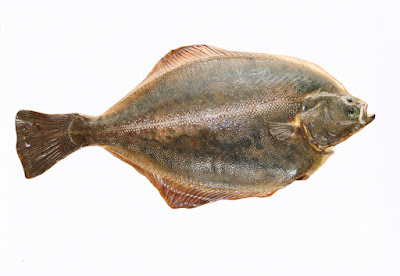
True asymmetry is so unusual that when you see it, it really stands out as weird.  Consider the bizarre-looking flounder:

[Image licensed under the Creative Commons Peter van der Sluijs, Large flounder caught in Holland on a white background, CC BY-SA 3.0]

Flounders start out their lives as ordinary little fish, upright with symmetrically-placed eyes, fins, and so on.  But as they mature, their skulls twist and flatten, and they end up with both eyes on the same side of the head -- a great adaptation for a fish that spends its life lying flat on the seabed, and who otherwise would constantly have one eye pointing downward into the mud.

A question I've asked here before has to do with the constraints on evolution; which of the features of life on Earth are so powerfully selected for that we might expect to see them in life on other planets?  (An example of one that I suspect is strongly constrained is the placement of the sensory organs and brain near the front end of the animal, pointing in the direction it's probably moving.)  But what about symmetry?  There's no obvious reason why bilateral symmetry would be constrained, and it seems as if it might just be a holdover from the fact that our earliest ancestors happened to be bilateral, so we (with a few stand-out exceptions) have inherited it down through the eons from them.

What about symmetry in general, however?  If we went to another life-bearing planet, would we find symmetrical organisms, even if they differ in the type of symmetry from ours?

The answer, judging from a paper that appeared this week in Proceedings of the National Academy of Sciences, by a team led by Iain Johnston of the University of Bergen, appears to be yes.

What Johnston and his team did was analyze the concept of symmetry from the perspective of information theory -- not looking at functional advantages of symmetry, but how much information it takes to encode it.  There are certainly some advantages -- one that comes to mind is symmetrically-placed eyes allows for depth perception and binocular vision -- but it's hard to imagine that's a powerful enough evolutionary driver to account for symmetry in general.  The Johnston et al. research, however, takes a different approach; what if the ubiquity of symmetry is caused by the fact that it's much easier to program into the genetics?

The authors write:

Engineers routinely design systems to be modular and symmetric in order to increase robustness to perturbations and to facilitate alterations at a later date.  Biological structures also frequently exhibit modularity and symmetry, but the origin of such trends is much less well understood.  It can be tempting to assume—by analogy to engineering design—that symmetry and modularity arise from natural selection.  However, evolution, unlike engineers, cannot plan ahead, and so these traits must also afford some immediate selective advantage which is hard to reconcile with the breadth of systems where symmetry is observed.  Here we introduce an alternative nonadaptive hypothesis based on an algorithmic picture of evolution.  It suggests that symmetric structures preferentially arise not just due to natural selection but also because they require less specific information to encode and are therefore much more likely to appear as phenotypic variation through random mutations.  Arguments from algorithmic information theory can formalize this intuition, leading to the prediction that many genotype–phenotype maps are exponentially biased toward phenotypes with low descriptional complexity.

Which is a fascinating idea.  It's also one with some analogous features in other realms of physiology.  Why, for example, do men have nipples?  They're completely non-functional other than as chest adornments.  If you buy intelligent design, it's hard to see what an intelligent designer was thinking here.  But it makes perfect sense from the standpoint of coding simplicity.  It's far easier to have a genetic code that takes the same embryonic tissue, regardless of gender, and modifies it in one direction (toward functional breasts and nipples) in females and another (toward non-functional nipples) in males.  It would take a great deal more information-containing code to have a completely separate set of instructions for males and females.  (The same is true for the reproductive organs -- males and females start out with identical tissue, which under the influence of hormones diverges as development proceeds, resulting in pairs of very different organs that came from the same original tissue -- clitoris and penis, ovaries and testicles, labia and scrotum, and so on.)

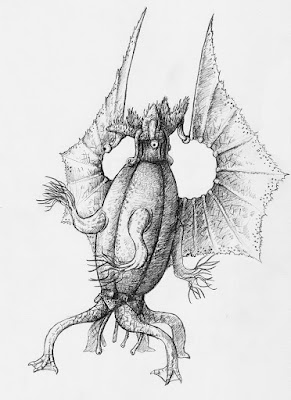
So symmetry in general seems to have a significant enough advantage that we'd be likely to find it on other worlds.  Now, whether our own bilateral symmetry has some advantage of its own isn't clear; if we landed on the planets orbiting Proxima Centauri, would we find human-ish creatures like the aliens on Star Trek, who all looked like people wearing rubber masks (because they were)?  Or is it possible that we'd find something like H. P. Lovecraft's "Elder Things," which had five-way symmetry?

And note that even though the rest of its body has five-way symmetry, the artist drew it with bilateral wings. We're so used to bilateral symmetry that it's hard to imagine an animal with a different sort. [Image licensed under the Creative Commons Українська: Представник_Старців (фанатський малюнок)]

So that's our fascinating bit of research for today; coding simplicity as an evolutionary driver.  It's a compelling idea, isn't it?  Perhaps life out there in the universe is way more similar to living things down here on Earth than we might have thought.  Think of that next time you're looking up at the stars -- maybe someone not so very different from you is looking back in this direction and thinking, "I wonder who might live on the planets orbiting that little star."

**************************************

Tuesday, March 15, 2022

Accent contagion

One of the features of linguistics I find the most interesting is regional accents.

Americans are usually aware of this phenomenon apropos of English in the United States; it doesn't take any great skill to detect a difference between speech amongst natives of Maine, Mississippi, and Minnesota.  It's a phenomenon that is hardly limited to the US, however.  I heard loud and clear the differences between English spoken in Cornwall, Suffolk, Yorkshire, and Durham when I was in England.  And I still recall when I was in a band that played French music, and we had a gig at Cornell University.  Afterward, a very nice couple with a distinctly French-from-France accent came up afterward.

"We loved your singing," they said to me, "and your French is excellent.  But where are you from?  You don't sound Parisian or any of the accents from southern France, and you're definitely not Québecois."

I said, "My family is from Louisiana."

The light bulb went on.  "Ah!" the man said, smiling.  "Of course!"

I guess the Cajun still comes through, even though I haven't lived in my home state in forty years.

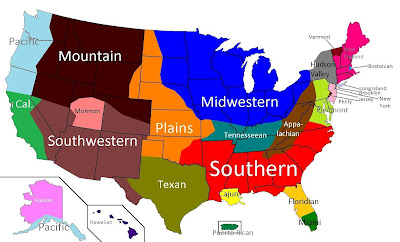
What I find even more interesting is how resistant my English-speaking accent has been to change, despite living in YankeeLand for decades.  I took the New York Times Accent Quiz, and even though I feel like my mode of speech has been pretty well homogenized from ten years in Seattle and thirty in upstate New York, the three cities that I scored the highest matches with were Shreveport, Louisiana, Biloxi, Mississippi, and Houston, Texas.

Connect those three into a triangle, and where I grew up is pretty much right in the middle.

The test relies not only on differences in pronunciation (e.g., of the words "merry," "Mary," and "marry," which ones, if any, are said the same way?) but in identifiable regional words.  For example:

  • What do you call the children's playground equipment that's a long board that pivots in the middle, so two kids on opposite ends can take turns going up and down?
  • What do you call the strip of ground running along the side of a road?
  • What do you call fizzy sweetened drinks?
  • What do you call a machine affixed to a wall that provides cold water to drink?
  • What do you call a residential road with a green space running down the middle?

(My answers, if you're curious: teeter-totter, verge, soda, water fountain, boulevard.)

Of course, there are a few dead giveaways.  My use of the word "y'all" as a second-person plural pronoun pinpoints me in the southeast of the country right from the outset.  And there are a few bizarre regionalisms -- the most striking one, that none of my friends who took the test had even heard of, is the strange expression "the devil is beating his wife" for the phenomenon of rain falling while the sun is shining.  (No, I have no idea where it comes from, but I can remember my dad saying that when I was little.  Apparently it is of uniquely southern-Louisiana provenance.)


What brings this up is a study from the University of Pennsylvania that appeared in the journal Language last week, looking not only at regional accents but in an odd phenomenon called linguistic convergence -- that people tend to imitate the accents they hear, often unconsciously, resulting in phonetic conventions not native to the person's own region or ethnic background showing up in their speech.

The specific one they looked at was the so-called "long i" sound, more technically the diphthong /ai/, as found in the English words "ride" and "dine."  In a lot of parts of the American southeast, that diphthong gets flattened out to /æ/, the vowel sound in the standard English pronunciation of "cat."

What they found was that if a (non-southeastern US) English-speaking test subject was exposed to someone who did have a southeastern accent -- but who had been instructed beforehand not to use any words that had the /ai/ -> /æ/ diphthong shift -- and then instructed to read a list of words, the test subject was more likely to say something closer to /ræd/ and /dæn/ than the standard pronunciations of /raid/ and /dain/.

Evidently hearing southeastern accents makes you likely to adopt southeastern-sounding phonetics, even if you haven't heard the particular phonetic shift in question.

What's interesting about this is that it's not only unconscious, it's temporary -- when time has elapsed and speech is heard using the test subject's native regional accent, the effect goes away.  But we apparently have a mental representation of what "talking southern" sounds like, and that finds its way into our speech when we hear it.

My wife, I've noticed, has a tendency to do this -- she picks up accents, and has to work actively to halt it (she's very conscious of not wanting people to think she's mimicking or mocking them).  I'm not sure if I do it -- I'll have to ask her to pay attention next time we're in a place where the accent is different from mine.

My question, of course, is why?  Humans learn a lot when we're little through mirroring both what we hear and what we see.  Is this a holdover from the way we learn language when we're children?  Or is it some kind of unconscious attempt to fit in with the people we're talking to, to seem less "other" than we would have?  The underlying cause was beyond the scope of the current research, but it's an interesting question about something that seems to be a universal tendency.

So next time you're around someone who speaks with a different accent than yours, keep your ears perked.  I wonder if the fact that you're now aware of this will make it less likely to happen?  Maybe your accent will bleed over into the person you're talking to.  Let me know what happens to y'all, y'hear?

**************************************