Skeptophilia (skep-to-fil-i-a) (n.) - the love of logical thought, skepticism, and thinking critically. Being an exploration of the applications of skeptical thinking to the world at large, with periodic excursions into linguistics, music, politics, cryptozoology, and why people keep seeing the face of Jesus on grilled cheese sandwiches.

Thursday, January 26, 2023

Strange attractors

A couple of months ago, I read Paul J. Steinhardt's wonderful book The Second Kind of Impossible, about his (and others') search for quasicrystals -- a bizarre form of matter that is crystalline but aperiodic (meaning it fills the entire space in a regular fashion, but doesn't have translational symmetry).  Here's an artificial quasicrystal made of aluminum, palladium, and manganese:
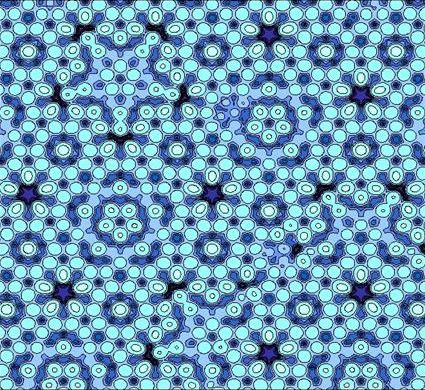
[Image is in the Public Domain courtesy of the United States Department of Energy]

As the above photograph shows, they can be created in the lab, but Steinhardt believed they could occur naturally -- and he finally proved it, in a meteorite sample he and his team found in a remote region of Siberia.

I was immediately reminded of Steinhardt's aperiodic crystals when I read a paper in Chaos: An Interdisciplinary Journal of Nonlinear Science, by Francesca Bertacchini, Pietro Pantano, and Eleanora Bilotta, of the University of Calabria, who were experimenting with another nonrandom but chaotic shape -- a "strange attractor."

A strange attractor is a concept from fractals and chaos theory, and represents a value toward which a perturbed system tends to evolve.  Chaos theory has been around for a while, but came to most people's attention from Jurassic Park, when the character Ian Malcolm (portrayed in memorable fashion by Jeff Goldblum) is explaining the unpredictability of complex systems using the direction a drop of water rolls on a relatively (but not perfectly) flat surface, in this case, the back of someone's hand.  Systems like that one tend to rush far out of equilibrium -- once the drop starts to move, it keeps going -- but some systems settle into a set of loops or spirals, as if something in the middle was drawing them in.

Thus the name strange attractor.

These systems, when mapped out, create some beautiful patterns -- like Steinhardt's quasicrystals, with the superficial appearance of regularity, but without any repeats or obvious symmetries.  Bertacchini et al. used the mathematical functions describing the system to drive a 3-D printer and actually create models of what strange attractors look like.  The team was struck with how beautiful the shapes were, and had a goldsmith fashion them as jewelry.  Here are a few of their creations:


They look a little like Spirograph patterns gone off the rails, but they have a striking, almost-but-not-quite-symmetrical shape that keeps drawing the eye back.

The authors write:

[We used] a chaotic design approach used to develop jewels from chaotic design.  After presenting some of the most important physical systems that generate chaotic attractors, we introduced the basic steps of this approach.  This approach exploits a number of fundamental characteristics of chaotic systems.  In particular, the parametric design approach exploits the concept of extreme sensitivity to the initial data that leads to evolutionary transformations of dynamic systems, not only along the traditional routes to chaos and through qualitative changes in the starting chaotic system, but also through changes in the basic parameters of the system, which create infinite chaotic forms.  Such phase spaces, therefore, represent an enormous potential to be exploited in the design of artistic objects, whether they are jewelry pieces or other objects of abstract art. In the computational approach used, each shape is unique and it is identified by a set of parameters that almost constitute its precise value.  This leads to the creation of unique artistic forms and, thus, to the customization of products in the case of jewelry pieces, which exploits chaotic design as a methodology.

The whole thing brings up for me the mysterious question of what we find beautiful -- and how so often, it's a balance between predictability and unpredictability, between symmetry and randomness.  It reminds me of the quote from the brilliant electronic music pioneer Wendy Carlos: "What is full of redundancy is predictable and boring.  What is free from all structure is random and boring.  In between lies art."

****************************************


Wednesday, January 25, 2023

Relocating Pergamum

Today is the launch of my hero's journey novel Sephirot!  An ordinary man is suddenly catapulted into a network of interconnected worlds where nothing is as it seems, and he has to rely on his wits and courage to find his way through.  But will that be enough to get him safely home?

Get your copy, and also sign up for my monthly newsletter and other special offers, at my website!

****************************

Jonathan Swift commented, with his usual eagle-eyed clarity, "You cannot reason a person out of a position he did not reason himself into."

This, in a nutshell, sums up why it is so damned frustrating to argue with conspiracy theorists.  Not only do they summarily dismiss any facts you might come up with, they have abandoned the necessity for facts at all.  They've moved from the faith-based stance of "believe this despite the fact that there's no evidence" to "believe this because there's no evidence."  After all, those conspirators are pretty smart guys.

They wouldn't just leave evidence lying around.

But once you've landed in that territory, you've opened yourself to falling for anything.  As an example, consider the latest bizarre conspiracy theory that's been making the rounds, that has repeatedly caused the people who run Wikipedia to have to go back and fix the pages for an archaeological site in Turkey and an obscure Roman Catholic bishop who is the patron saint of toothache.

I swear I'm not making any of this up.

The whole thing started with a passage from the Book of Revelation -- specifically, Revelation 2:12-17:

To the angel of the church in Pergamum write:

These are the words of him who has the sharp, double-edged sword.  I know where you live—where Satan has his throne.  Yet you remain true to my name.  You did not renounce your faith in me, not even in the days of Antipas, my faithful witness, who was put to death in your city—where Satan lives.

Nevertheless, I have a few things against you: There are some among you who hold to the teaching of Balaam, who taught Balak to entice the Israelites to sin so that they ate food sacrificed to idols and committed sexual immorality.  Likewise, you also have those who hold to the teaching of the Nicolaitans.  Repent therefore!  Otherwise, I will soon come to you and will fight against them with the sword of my mouth.

Whoever has ears, let them hear what the Spirit says to the churches.  To the one who is victorious, I will give some of the hidden manna.  I will also give that person a white stone with a new name written on it, known only to the one who receives it.

Notwithstanding the fact that most of the Book of Revelation sounds like a bad acid trip, this seems clear enough.  The people of Pergamum are pretty okay for the most part, except for those who eat the sacrificial lamb or fool around out of wedlock; to them the angel says, "Don't make me come over there and give you a good talking-to."

Simple, right?  Nope.  There's a group of conspiracy theorists who have grabbed the "where Satan has his throne" part, and run right off the cliff with it.

The Antipas mentioned in the passage was a real guy; he was the bishop of Pergamum, and was martyred either during the reign of Nero or Domitian (it's uncertain which), allegedly by being placed inside a hollow brass bull and roasted over a fire.  Somehow, he became the patron saint of toothache, instead of the patron saint of third-degree burns, which would have been more logical.

So the conspiracy theorists put their mind to trying to figure out where Satan's throne is.  They reasoned, "Well, the biblical passage says that it's in the city where Antipas died, so if we can just figure out where that was, we'll know where Satan's throne is located!"

Um... let's reread the passage, shall we?


It says right in the first line of the passage that the city is called Pergamum.  Antipas is known to have been the bishop of Pergamum.  Not only that, Pergamum was a huge metropolis of the ancient world, which left a sprawling set of much-studied ruins (now a UNESCO World Heritage Site) located in what is now western Turkey.  The city was settled in the eighth century B.C.E., inhabited continuously through the Hellenistic, Roman, and Byzantine Eras, is documented hundreds of times in contemporary sources, and was only more or less abandoned in 1300 C. E. when the Ottoman Turks took over.  Furthermore, the district within which the archaeological site is located...

... is still called Bergama.

Despite all this, the conspiracy theorists were sitting around and scratching their heads in total perplexity.  "This is really complicated, dude," they said.  "Where can it be?  They sure hid Satan's throne well, those sneaky guys!"

But you'll be relieved to know that after much pondering, they figured it out.  Antipas of Pergamum was actually buried in...

... wait for it...

... Geneva, Switzerland.

Why Geneva, you might be asking?  I know I sure as hell was.  Well, they're happy to explain that it's because Geneva is home to the following evil organizations:

  1. The CERN particle accelerator 
  2. World Economic Forum Headquarters
  3. World Trade Organization
  4. World Council of Churches
  5. World Federation of United Nations
  6. World Health Organization
  7. World Meteorological Organization
  8. International Lesbian, Gay, Bisexual, Trans and Intersex Association
  9. GAVI (The Vaccine Alliance)
  10. Lutheran World Federation
  11. Internet Governance Forum
  12. UN Watch
Okay, I can see them targeting CERN, given that the mad scientists there are currently trying to recreate the Big Bang or generate black holes or trigger a false vacuum collapse, so that they will enjoy 3.8 nanoseconds during which to cackle maniacally and rub their hands together in glee before they get vaporized along with the rest of us.  It's also unsurprising that an association supporting us evil queer folks made the top twelve.  And a lot of the others on the list have that "One World Government" flavor conspiracy theorists just hate. 

But... the Lutherans?  Why target the Lutherans?  What do they think the Lutherans are gonna do, organize Satan's dish-to-pass supper, or something?

What is most baffling about all this is not that some loon had a crazy idea.  That's what loons do, after all.  What is completely mind-boggling about all this is that when said loon posted this idea, he got shouts of acclamation about his bravery in coming forth with it, along with people decrying the evil folks of Geneva as being -- once again, I'm not making this up -- "vile, in plain sight, such evil."  And enough people took a look at this claim and said, "Makes sense to me," that the Wikipedia pages for Antipas, Pergamum, and Geneva keep having to be fixed over and over after they're edited to reflect this new and groundbreaking version of reality.

I'm not sure what more to say about this that "What the actual fuck?" doesn't cover.  One slightly hopeful note is that this kind of thing usually has a fairly short shelf-life; the conspiracy theorists get bored with yammering about one weird idea and then move on to something else in fairly short order.  Probably this time that Newark is actually located in Cambodia and is the final resting place of Mussolini, or something.

Okay, so I'm not sure how reassuring this actually is.

One thing that's certain, though, is that as useless as it seems, I will keep fighting against the purveyors of nonsense with the sword of my mouth, lo until the end of days.  Maybe I'll even get rewarded with a white stone with a new name on it.  You never know.

****************************************


Tuesday, January 24, 2023

The forest primeval

There are some truly astonishing features of living things that are so familiar we stop even thinking about them, and somewhere near the top of that list are plant roots.

The evolution of true roots, which occurred back in the Silurian Period (444 to 419 million years ago), was a major advance over plants like bryophytes (a modern example is moss) that have only simple, unbranched extensions of the stem to hold them in place.  One of the first vascular plants -- plants with internal plumbing, allowing them to transport materials far more efficiently, and therefore grow much taller -- was Cooksonia, a bizarre-looking leafless plant that was nothing more than a bunch of stems each ending in a bulbous spore-production device.

By the Devonian Period (419 to 359 million years ago), this innovation had spread like wildfire, and plants related to today's ferns, horsetails, and club mosses had pretty much taken over the landscape.  There were still no flowering plants -- those wouldn't show up for another two hundred million years -- but our familiar mental image of prehistoric swamps, thick with giant ferns and conifers, populated by enormous dragonflies and centipedes, isn't so far off from the truth.

The reason this comes up is the recent discovery I learned about from a loyal reader of Skeptophilia, of a fossil site near Gilboa, New York, only a couple of hours east of where I live.  Virtually all of the rock in the southern tier region of New York is Devonian in age, mostly fossil-rich shales and limestones, and in an abandoned quarry paleontologists have discovered the fossils of an intricate (and huge) root network from an ancient forest.

The forest was primarily composed of members of two groups: the genus Archaeopteris, which looked a bit like modern Norfolk Island pines, although much more closely related to tree ferns:

[Image licensed under the Creative Commons Retallack, Archaeopteris reconstruction, CC BY-SA 4.0]

The other were the cladoxylopsids, which look like they were invented by Dr. Seuss:

[Image licensed under the Creative Commons Falconaumanni, Pseudosporochnales reconstruccion, CC BY-SA 3.0]

The site is being studied by a team led by paleontologists at nearby Binghamton University, who have thus far mapped over three thousand square meters of this forest extremely primeval.  They have speculated that when it was at its height, 386 million years ago, it extended all the way down into what is now northern Pennsylvania.

"It is surprising to see plants which were previously thought to have had mutually exclusive habitat preferences growing together on the ancient Catskill delta," said Chris Berry, of Cardiff University's School of Earth and Ocean Sciences, who co-authored the study.  "This would have looked like a fairly open forest with small to moderate sized coniferous-looking trees with individual and clumped tree-fern like plants of possibly smaller size growing between them."

This was toward the end of the Devonian, at which point the Earth was heading into a huge warm-up, leading to the sauna-like climate of the Carboniferous swamps.  During the Carboniferous Period, plants kind of took over the place, leading to oxygen levels of perhaps as high as 35% (compared to our current 21%).  The carbon dioxide sucked from the atmosphere and deposited as coal -- coal we are burning today, returning that primordial carbon to the modern air -- was putting gunpowder in the keg, setting up the biggest cataclysm life ever endured.  All through the Carboniferous and Permian Periods, the coal deposition continued, even as the temperature cooled (because of removal of the carbon dioxide).  Then, at the end of the Permian, one of the largest volcanic eruptions ever, the supervolcano that created the Siberian Traps, poured out an unimaginable four million cubic kilometers of basaltic lava.  That molten rock ripped through enormous swaths of buried Carboniferous and Permian coal, blowing all that carbon back into the atmosphere, along with large quantities of sulfur.

The result?  A sudden and massive jump in temperature, a catastrophic drop in atmospheric oxygen, and widespread oceanic anoxia and acidification.  The Permian-Triassic Extinction ensued, during which an estimated ninety percent of species on Earth went extinct.

But when the quarry site was a thriving, fern-filled forest, that was still all in the future.  What is now the maple and oak woodlands of the Catskills was a swampy, lowland thicket of some very strange-looking trees.  Fascinating that sitting here, 386 million years later, we can get a picture of what life was like back then, when the ecosystem was being shaped by one of the most important developments in plant evolutionary history -- roots.

****************************************


Monday, January 23, 2023

A lens into the past

The third of C. S. Lewis's Space Trilogy, That Hideous Strength, is not without its serious flaws (itself an interesting topic and perhaps something I'll look at another time), but is a riveting adventure story even so, with twists, turns, near misses, and a finale where (literally) the world of the story comes crashing down on the characters.

Central to the tale is the famous character of Merlin, the master magician from the Arthurian legends, who has been in a charmèd sleep after his dalliance with the sorceress Nimué (also known as Ninienne or Vivienne, depending on which version you read).  Lewis's story, set in immediately post-World-War-II Britain, involves two different groups, one good and one deeply evil, who are both trying to reawaken Merlin and harness his powers for their own purposes.  They both have figured out that the sorcerer's not-so-final resting place is a souterrain, or underground chamber, beside a well on the grounds of the (fictitious) Bracton College, and each is racing to get there first.

Lewis's placement of the venerable Merlin in a souterrain is justified; Iron Age Celtic settlements were riddled with them.  Their purpose is unknown.  They may have been used for storage, for ritual purposes, as a hiding place when they were attacked (all too common in that violent time), all three, or perhaps something else entirely.  Excavating souterrains is understandably fascinating to archaeologists, who hope to learn something of the history of the ancient Britons, who left virtually no written records (and very few surviving artifacts of any kind).

It's also backbreaking and dangerous work.  In the intervening centuries, cave-ins and erosion from groundwater have choked most souterrains with debris that has to be cautiously excavated and removed (hopefully not triggering further ceiling collapse in the process).  So people interested in the history of the Celts -- and other cultures who tunneled under their settlements -- will be excited to find out that a team from London-based AOC Archaeology has figured out a way to see into some Scottish souterrains -- without anyone going inside.

Using a Leica BLK360 laser scanner, they were able to create a 3-D computerized image of Cracknie souterrain, in Borgie Forest (north-central Scotland), a curving tunnel which is thirteen meters long and was built around two thousand years ago.

"Souterrains are still an enigma," said Matt Ritchie, resident archaeologist at Forestry and Land Scotland, who contributed to the project.  "Perhaps they were for storage, such as grain in sealed pots or dairy products like cheese.  Perhaps they were for security, keeping valuables safe, or slaves or hostages secure.  Or perhaps they were for ceremonial purposes, for household rituals, like a medieval shrine or private chapel...  [Cracknie souterrain] is one of the most important scheduled monuments on Scotland's national forests and land...  To do the equivalent of what we did with a theodolite [a precision optical instrument often used to map out caves], you would be there a long time."

Here's the map the laser scanner created:


This is only the beginning, of course; once you have proof-of-concept, the technology is bound to improve.  Soon, it will likely be possible to get a detailed image of the interior of a rubble-choked cavern where humans haven't set foot for millennia -- without moving a single pebble.

I, for one, can't wait to see what they find.  I'm one-quarter of Scottish descent, and have always felt a particular fascination for the history, language, music, and culture of the Celts.  It would be amazing to have a laser-powered lens into their past -- and a better idea of how my distant ancestors lived thousands of years ago.

And if they do end up finding Merlin, I'm all for waking him up.  This world could use a good dose of Elder Magic.

****************************************


Saturday, January 21, 2023

Tooth and claw

Aficionados of The X Files will no doubt recall "Field Trip," which ranks amongst the creepiest, twistiest, most atmospheric episodes they ever did.  Fox Mulder and Dana Scully are charged with investigating the disappearance of a young couple while on a hiking trip -- and after that, their mantra "Trust nothing and no one" becomes literally true.


What had happened (obviously, *spoiler alert*) is that first the couple, and then Mulder and Scully, had been attacked by an underground fungus that works in a particularly insidious way.  Inhaling the spores, which are released whenever you take a step on the ground, induces hallucinations intended to make you hold still while the fungus slowly digests you.  It stimulates your brain with images while dissolving away your body.  Every time the real reality -- the tendrils of slime mold creeping across your skin -- intrudes, the hallucinations become more intense, more engaging, more real.

Until there's nothing left of you to fight back.

While the details of the episode are fiction, nature itself has plenty of examples that are just as horrifying.  The pathogen Toxoplasma gondii, common not only in humans but in domestic cats, wild mice, and rats, alters the brains of the hosts, but each in its own way.  Rats and mice become unafraid of predators, and in fact become attracted to the scent of cat urine; cats and humans become more affectionate -- and neurotic.  Each of those alterations in behavior is engineered by the parasite to maximize its chances of jumping to another host.  Lancet worms (Dicrocoelium dendriticum) parasitize ground-dwelling ants, and induce them to climb blades of grass and simply wait there, because the worm has a second stage of its life cycle in which it has to pass through the digestive tract of a ruminant, like a deer or a cow.  So it basically triggers the ant to commit suicide so it can make the jump.  Worse of all -- and most like the fungus in "Field Trip" -- there are the baculoviruses, which infect caterpillars.  Once parasitized, the caterpillars become attracted to sunlight, so they climb to the very tops of tree branches, where they die.  And then explode, showering their comrades lower down in the tree with viral particles.

Another way that "Field Trip" got it right, though, was some of the nasty stuff pulled by members of kingdom Fungi.  You have to wonder how we ever figured out that any of them were edible:


Not only are some of them amongst the most toxic living things known (the closely-related death cap [Amanita phalloides] and destroying angel [Amanita bisporigera] mushrooms, for example), they have a lot of other insidious strategies.  Most fungi are decomposers, but like the fungus in "Field Trip," a few of them have developed methods for hastening their unfortunate prey into decomposition.

This, in fact, is why the topic comes up; a new study of oyster mushrooms (Pleurotus ostreatus) found that the underground mycelium (network of root-like tubes) of the species actually hunts and kills nematodes (roundworms) using something one of researchers described as "a lollipop filled with nerve gas."  The toxocysts, as the lollipops are called, are consumed by the nematodes, and when they burst, it releases a chemical called 3-octanone, which triggers calcium to flow into the muscles of the worm.  This paralyzes it -- and the fungus has dinner.

Oyster mushrooms aren't the only species that goes after nematodes.  It makes sense to choose them as prey; nematodes are one of most numerous animals in the world.  I still recall my invertebrate zoology professor grossing us all out (something he specialized in) by telling us that if you made all organic matter disappear except for nematodes, you could still see where all the other life forms were by the haze of parasitic nematodes they'd been carrying, outlining where they'd been like some kind of ghostly remnant of their bodies.

But the fungi still maintain the upper hand.  There are fungi which have evolved harpoons for skewering nematodes.  Others create what amount to glue traps.  One species produces something like a spiked collar -- with the spikes pointing inward.  The weirdest one is the fungus Arthrobotrys oligospora, which creates a noose.  When a nematode crawls through the noose, the loop suddenly inflates, strangling the hapless worm, which is then digested.

Nature is red in tooth and claw, man.  And it's not just the animals.  Remember the first line of Stephen King's wonderful novel The Girl Who Loved Tom Gordon: "The world had teeth, and could bite you with them any time it wanted."

Truer words never spoken.

Anyhow, I've probably skeeved you out sufficiently for one day.  Just think about all this next time you see innocent-looking little mushrooms popping up in your lawn. 

You never know what's going on beneath the surface.

****************************************


Friday, January 20, 2023

Jerusalem, in England's green and pleasant land

A loyal reader of Skeptophilia asked me, rather offhand, if I'd heard of "British Israelism."  I hadn't, and he went on to explain that it's the idea that the British (and therefore Americans of British ancestry) are the descendants of the Ten Lost Tribes of Israel.

As soon as I heard that last bit, I said, "Uh-oh."  I did a piece a while back about the fact that there are so many groups claiming to be the descendants of the Ten Lost Tribes that calling them "lost" is something of a misnomer.  In fact, if you do any reading on the topic, you'll come away with the impression that you can't throw a rock without hitting a Ten Lost Tribesman.

Delegation of the Northern Kingdom of Israel bringing gifts to Assyrian King Shalmaneser III [Image licensed under the Creative Commons Osama Shukir Muhammed Amin FRCP(Glasg), Black Obelisk side 4 Jewish delegation, CC BY-SA 4.0]

But even so, the British Israelists are in a class by themselves, given how thoroughly fleshed-out their ideas are.  I mean, the ideas are horseshit, but it's amazingly detailed horseshit.  Here are a few of their chief tenets:
  • The Ten Lost Tribes were not Jews.  More on that in a moment.
  • The Scythians were the ancestors of the Scottish people.  Because, y'know, both start with "Sc" and all.
  • The Saxons were connected to Isaac, son of Abraham.  "Saxon" comes from "[I]saac's sons."
  • All of the place names that have a syllable of the form "/d/-vowel-/n/" come from the Tribe of Dan.  So London, Dunkirk, Dundee, and... I shit you not... Danube, Denmark, and Macedonia.  Also, this has something to do with the Tuatha Dé Danann, "the children of Danu," who were a supernatural race revered in pre-Christian Ireland.
  • The royal family of Britain descends from King David of Israel.  Because reasons, apparently.
  • The English are from the Tribe of Ephraim, and Americans are from the Tribe of Manasseh.  Don't ask me how this works, because even after reading about it fairly extensively, I have no idea.
Well, the first thing that comes to mind about all of this is that the Israelists have broken a cardinal rule, to wit, "don't fuck with a linguist."  None of their supposed etymologies are even within hailing distance of the truth.  Just looking at the "Tribe of Dan" ones -- of which none have anything to do with the Tribe of Dan -- let's start with Dundee and Dunkirk, which both contain the Celtic word dun meaning "fort" (as do Dunblane, Duncannon, Dunearn, Dunfermline, and dozens of others).  London comes from the Latin Londinium (which was probably a latinization of a Celtic place name).  Danube comes from the Celtic Danu (the same gods referenced in the Tuatha Dé Danann, but the fact that they were right about that one thing brings to mind my dad's remark that "even a stopped clock is right twice a day").  Denmark comes from a Germanic tribe called the Dani.  Finally, Macedonia comes from the ancient Greek Î¼Î±ÎºÎµÎ´Î½ÏŒÎ¹, which means "tall people."

Put a different way, linguistics is not some kind of bastard child of free association and the Game of Telephone.

The bottom line is, it's mighty odd if the English are direct descendants of the Israelites, there is not a shred of evidence -- anthropological, genetic, linguistic, or archeological -- of that connection.  What the Israelists have is an amalgam of quasi-evidence (mostly in the form of folk legends and mythology), mixed well with misinterpretations and outright falsehoods.  Despite all that -- to my astonishment -- it still has its fervent adherents, including the leaders of the Church of God International and the members of the Christian Identity movement.

Where it gets uglier, though, is that the Israelists, especially after the idea took hold in the United States, devolved into sickening levels of antisemitism.  This initially puzzled me, because you'd think that any group so gung-ho about the Israelites would be equally chummy with the Jews, but no.  The leading proponents of the idea have taken great pains to distance themselves from modern-day Jews, whom they consider "usurpers" and "imposters."  Some go so far as to believe that modern Jews aren't the descendants of the Israelites at all, but come either from Adam having sex with the demonic Lilith, or the Serpent having sex with Eve, or possibly both.  Anthropologist Michael Phillips, commenting on this bizarre doctrine, said that the belief allowed an adherent to "maintain his anti-Semitism and at the same time revere a Bible cleansed of its Jewish taint."

All of which illustrates something we've seen here before, which is that bigoted assholes will latch on to any gossamer scrap of evidence they can find to support their abhorrent ideas, and failing that, will make some up.

Anyhow, to the reader who sent me the link, thanks for sending me down a several-hours-long rabbit hole that left me thinking if the Daleks ever invade the Earth, I might just tell 'em, "Exterminate away, little buddies, there's no intelligent life down here anyhow."  Every time I think I've plumbed the absolute depth of stupidity, I find that someone has found the bottom and started to dig.

****************************************


Thursday, January 19, 2023

Scripts and mysteries

My fascination with languages goes back a very long way.  I was raised bilingual -- French was my mother's first language, and all of her older relatives spoke French more often than English.  They especially tended to switch over to French when they were talking about things they didn't want me to understand, which I have to admit provides a kid a hell of an incentive to learn a language.

Another thing I loved when I was young (and still do) is puzzles.  I have always resonated with what physicist Richard Feynman called "the joy of figuring things out."  That flash of insight that allows you to solve a riddle is a nice little dopamine rush.

The combo is probably why I pursued a master's degree in historical linguistics.  Piecing together the etymologies of words, and tracing how they change and move from place to place, is like a gigantic linguistic puzzle.  My own particular area was how the Scandinavian languages influenced Old English and Old Gaelic during the Viking invasions of Great Britain, but etymology is just generally fascinating to me (which is why I started doing my daily #AskLinguisticsGuy feature on TikTok -- if you're interested in word origins, you should follow me).

One area that is way outside my skill set, though, is decipherment.  I've written here before about the stupendous work of Alice Kober and Michael Ventris in deciphering the Linear B Script of Crete, for which not only was the sound-to-symbol correspondence unknown, but it wasn't known what language it represented.  At first, they couldn't even be certain if it was read left-to-right or right-to-left, or if -- perhaps -- it was a boustrophedonic script, which alternates being read left-to-right and right-to-left every line.  (The odd word boustrophedonic comes from Greek; it means "the turning of an ox," because the back-and-forth writing reminded linguists of the way an ox plows a field, turning at the end of each row.  Examples of boustrophedonic scripts are Etruscan and Sabaean.)

If you're curious, Linear B turned out to be written in an early form of Mycenaean Greek, and the script was a combination of a syllabic script -- like the Japanese hiragana -- and ideographs, such as are used in written Chinese.  It's read left-to-right -- just as modern Greek is today.

The amount of skill and sheer brainpower it would take to figure all that out that absolutely boggles my mind.

If any of you are looking for a challenge, though, there are still a lot of undeciphered scripts out there.  Here are a few examples of writing systems that have defied decipherment -- thus far:

  • The Banpo symbols, from the fifth millennium B.C.E. in China.  They consist of twenty-two different symbols, and are always found on shards of pottery, leading some to speculate that they aren't writing, but are either just geometrical decorations or (possibly) what potters call a "chop," a mark or series of marks identifying the maker.  The fact that they're present on multiple pieces of pottery, in different orders, suggests that they might be written language, but no one knows for sure.
  • The Dispilio Tablet, a wooden artifact with what seem to be written characters.  It was found in 1993 in western Greece, and the shapes of the characters drew comparisons to both Linear B and Linear A (another Cretan script that is, thus far, undeciphered).  But the comparisons didn't allow linguists to crack the code, and as of right now, the Dispilio script, like Linear A, is still a mystery.
  • The Indus Valley script.  This is one of the most puzzling undeciphered scripts known, because it has been recorded from over four thousand inscriptions comprising strings of around four hundred different symbols, and has defied all attempts at decipherment.  Part of the problem is that we don't know what language was spoken by the people of the Harappan Civilization, which produced the writing and flourished in the Indus River Valley for two millennia, between 3300 B.C.E. and 1300 B.C.E.  At the end of that long period of dominance, their cities and farming communities were suddenly abandoned, and although climate change, disease, and invasion have been suggested as explanations, historians are at a loss to explain what actually happened.

A sequence in the Indus Valley script [Image licensed under the Creative Commons Siyajkak derivative work: Gregors (talk) 08:30, 31 March 2011 (UTC), The 'Ten Indus Scripts' discovered near the northen gateway of the citadel Dholavira, CC BY-SA 3.0]

  • Proto-Elamite, a script used from around 3200 to 2700 B.C.E. in what is now western Iran.  Later, the Elamites adopted cuneiform, but their earlier writing system is still undeciphered.
  • Southwestern Paleohispanic, a script used in southern Spain and Portugal from the eighth to sixth centuries B.C.E.  It's been associated with the Tartessian civilization, about which I've written here before, and which -- like the Harappans -- disappeared suddenly and inexplicably.  All attempts to link Southwestern Paleohispanic to Celtic, Etruscan, Latin, and Greek have been unsuccessful.
  • Zapotec, a glyphic script (like Mayan) used in what is now Oaxaca, Mexico up until about 700 C.E.  It is probably a written representation of an early ancestor of the Oto-Manguean language family, a cluster of about fifty languages from Mesoamerica whose relationship to other language families is uncertain at best.

That's just six of the best-known.  There are literally hundreds of other scripts, some fragmentary in nature or only known from one or two artifacts, that have thus far resisted all attempts at decipherment.

And if the whole business wasn't already complicated enough, there are also examples of asemic writing, which is writing without meaning -- writing either created to simulate meaningful scripts for use as decoration (such as the delightful Codex Seraphinianus) or done deliberately to fool people (which is likely to be the explanation for the Voynich Manuscript).  So linguists studying some of these undeciphered scripts have to keep in mind that the reason they've defied decryption might be because they aren't meaningful in the first place.

But, as I said, figuring that out is above my pay grade, not to mention my IQ.  I can only sit back in amazement and appreciate the work that has gone into figuring out all the thousands of ways humans have communicated, by linguists whose ability to tackle unfathomable puzzles is nothing short of astonishing.

****************************************